China Unveils New High-Speed Helicopter Prototype Resembling U.S. Sikorsky S-97 Raider
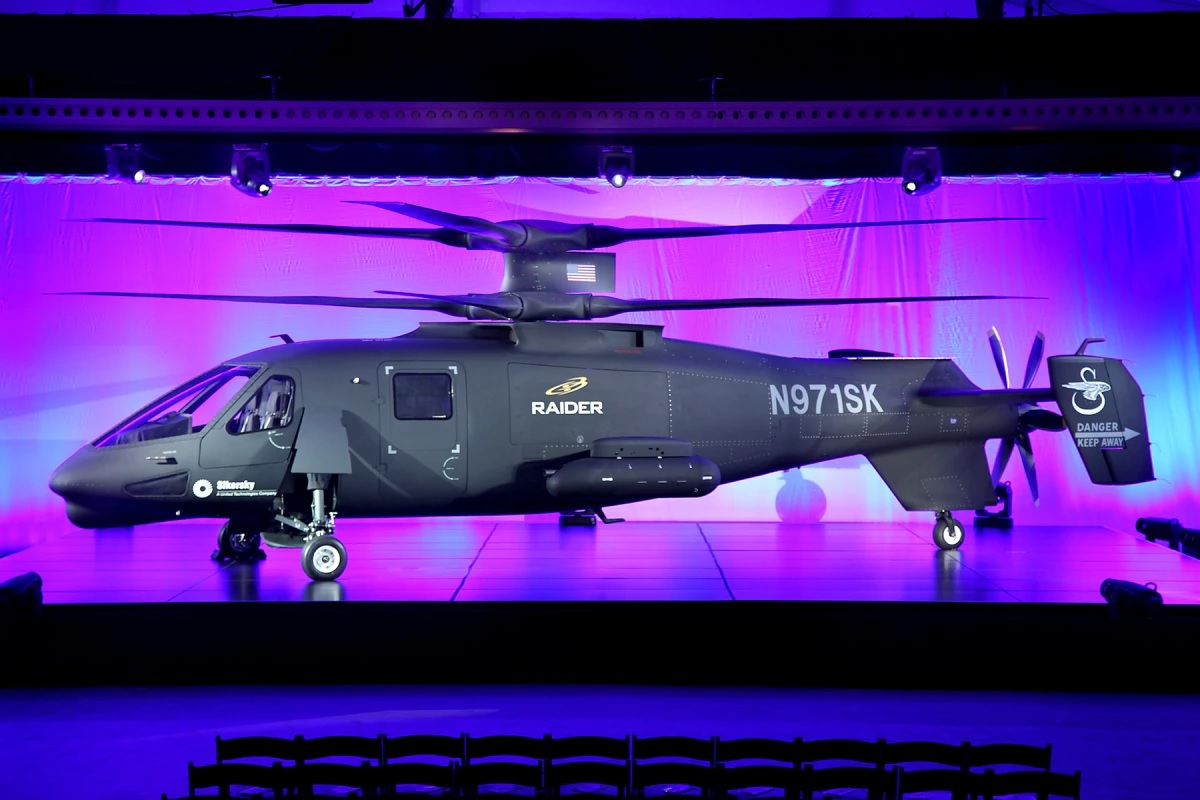
On August 21, 2025, new images and video of a Chinese prototype helicopter surfaced on the country’s social media platform Weibo, creating a wave of debate among military observers. The aircraft, filmed in flight, bears a striking resemblance to the U.S.-made Sikorsky S-97 Raider, a next-generation high-speed scout and attack helicopter. The footage revealed a design featuring a coaxial rotor system and a tail-mounted pusher propeller—the same advanced layout pioneered by Sikorsky in its Raider program.
A Design That Mirrors the Raider
The Chinese helicopter, informally called the “Future High-Speed Helicopter,” incorporates a coaxial counter-rotating main rotor coupled with a rear-mounted propeller to deliver both vertical lift and airplane-like forward thrust. This combination is designed to achieve far higher speeds than conventional rotorcraft.
Its narrow fuselage, tandem seating arrangement, and streamlined aerodynamic shaping point to intended missions such as reconnaissance and light assault operations in contested environments.
Key Differences in the Chinese Model
Despite the close resemblance, experts have noted several design differences that highlight the Chinese prototype’s less mature stage of development compared to the Raider:
-
Fixed landing gear instead of retractable landing gear.
-
Bulkier tail structures, lacking the refined aerodynamics of the Raider.
-
Simplified airframe elements, suggesting lower efficiency in airflow management.
-
Engine exhaust outlets positioned on either side of the fuselage between the rotor hub and tail boom, compared to the Raider’s optimized rear-facing exhausts that help reduce thermal signature and streamline airflow.
These differences suggest that while China has adopted the basic layout, it may still face aerodynamic, performance, and stealth challenges in refining the aircraft.
The Raider Benchmark
By comparison, the Sikorsky S-97 Raider represents the most advanced iteration of this rotorcraft concept. Developed under the U.S. Army’s Future Vertical Lift program, it has already demonstrated:
-
Speeds above 400 km/h, far exceeding traditional helicopter performance.
-
Sportscar-like agility, including tight turning, level acceleration, and rapid deceleration.
-
Optimized aerodynamics, with retractable landing gear and engine exhaust designed to lower heat signature.
-
A proven heritage of U.S. research into the Advancing Blade Concept, a lineage dating back to the 1970s and demonstrated with Sikorsky’s X2 technology demonstrator in 2010.
The Raider is considered one of the most advanced rotorcraft in the world, offering a combination of speed, maneuverability, and survivability unmatched by conventional helicopters.
Ambitions and Challenges for China
The emergence of the Chinese prototype highlights Beijing’s ambition to enter the high-speed helicopter domain, which has so far been dominated by U.S. industry.
Adopting this architecture could eventually allow China to field helicopters with greater tactical flexibility, including rapid reconnaissance, troop transport, and special operations capability. However, analysts caution that success depends on China’s ability to master complex flight control systems, advanced engines, and avionics integration—areas where the U.S. maintains a technological lead.
Strategic Implications
The prototype reinforces China’s broader defense aviation trend of mirroring American or Russian designs before adapting them to local requirements. If successful, the project could provide the People’s Liberation Army (PLA) with a fast, agile rotorcraft that would complicate the planning of regional militaries, particularly in the Indo-Pacific, where rapid mobility could prove decisive.
Even at this early stage, the new helicopter sends a clear signal: China intends to challenge U.S. dominance in next-generation helicopter technology. While the design appears less refined and far from mass production, its development demonstrates China’s resolve to reduce reliance on imported designs and achieve parity in advanced aerospace capabilities.
The unveiling of this Chinese high-speed helicopter prototype reflects both Beijing’s rising ambitions and its current limitations. While the aircraft strongly resembles the proven Sikorsky S-97 Raider, its less advanced details underscore the technological hurdles China must still overcome.
Nevertheless, the prototype is strategically important. Even as an early-stage project, it symbolizes China’s determination to compete head-to-head with the United States in next-generation rotorcraft development. If future testing and refinement prove successful, this aircraft could reshape the balance of regional air mobility and become a new factor in the Indo-Pacific’s evolving military landscape.
✍️ This article is written by the team of The Defense News.