China Unveiling Secrets of 1st Sample Taken From the Far Side of the Moon in Chang’e 6 Mission
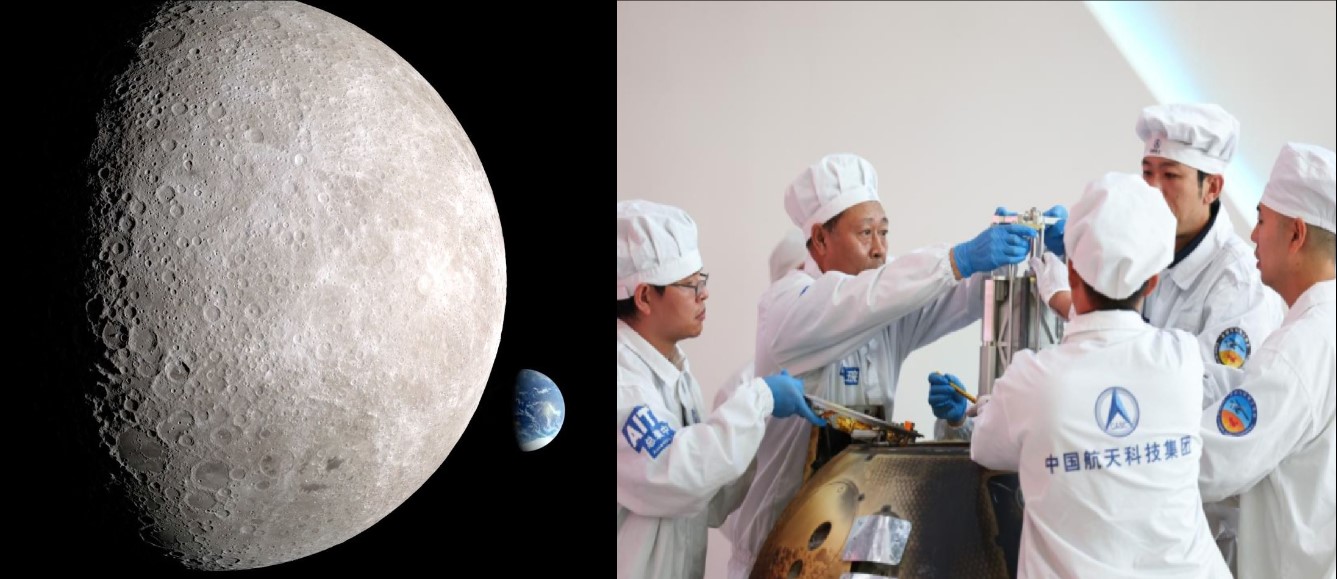
In a groundbreaking scientific revelation, China’s Chang’e 6 mission has returned the first-ever rock samples from the far side of the Moon, offering a rare glimpse into its geologic and volcanic history. The analysis of these samples, weighing 1.9 kilograms and collected from the South Pole-Aitken Basin, has reshaped our understanding of lunar evolution.
A Volcanic Landscape Frozen in Time
The samples revealed that volcanic activity on the Moon’s far side persisted until about 2.8 billion years ago. This finding was surprising, as previous studies suggested that volcanism on the Moon had largely ceased much earlier. Most known volcanic eruptions occurred on the near side, where radioactive elements like potassium and uranium generated internal heat. The far side, less rich in these elements, was thought to have cooled faster, ending its volcanic phase. However, Chang’e 6’s basalt samples—a form of hardened lava—challenge this narrative, showing that significant volcanic activity occurred well into the Moon's later stages.
Chemical Mysteries of the Moon's Mantle
The basalt samples analyzed by Chinese scientists, led by Zexian Cui from the Chinese Academy of Sciences, were found to be low in potassium, rare earth elements, and phosphorus—key components abundant in the near side’s volcanic regions. This disparity may stem from the massive impact that created the South Pole-Aitken Basin, which could have redistributed these elements and disrupted the mantle's composition beneath the far side. Such differences could explain why vast lava plains (mare basalts) cover 30% of the near side but only 2% of the far side.
Technical Insights from Chang’e 6
Chang’e 6 employed advanced drilling and scooping technologies to extract samples, ensuring the preservation of both surface and subsurface material. The samples included not just basalt but also non-mare materials like breccias, which may offer insights into the Moon’s crust and the remnants of ancient impacts. Radiometric dating of isotopes in these samples confirmed their age, while geochemical analysis provided clues about their origin and the Moon's internal structure.
Why It Matters
This discovery adds depth to our understanding of lunar geology, highlighting the Moon’s diverse evolutionary paths. The findings also underscore the importance of studying the far side, which had remained unexplored until China’s Chang’e missions. Beyond the Moon, these results provide a comparative framework for understanding volcanic processes on terrestrial planets, potentially offering clues about Earth’s early volcanic history.
China's efforts have not only filled a critical gap in lunar science but also demonstrated the value of international collaboration in space exploration. These samples open the door to new theories about the Moon's formation, the role of massive impacts in planetary evolution, and the enigmatic differences between its two hemispheres.
✍️ This article is written by the team of The Defense News.