China Strengthens Naval Combat Power with Upgraded Type 052D Destroyer Featuring New AESA Radar
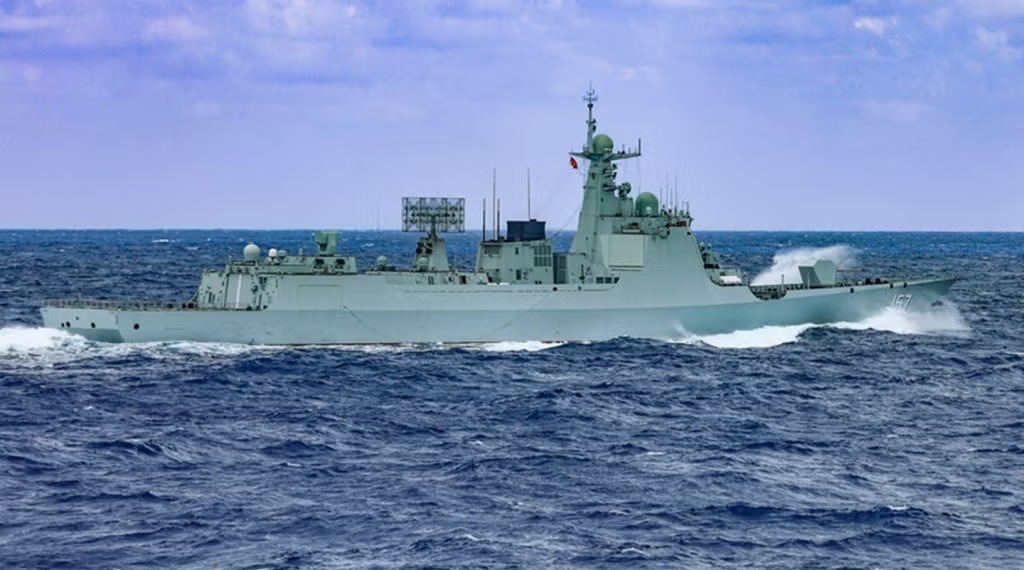
China has taken a major step forward in its naval modernization efforts by deploying an upgraded version of its Type 052D guided missile destroyer. Officially confirmed by the Southern Theater Command of the People’s Liberation Army (PLA) on June 2, 2025, the newly enhanced warship, named Weinan, participated in a large-scale maritime training exercise alongside other frontline vessels such as the Yulin destroyer.
These exercises, conducted across multiple maritime zones, were designed to test tactical coordination between warships, command decision-making, and combat readiness under simulated conflict conditions. The appearance of the upgraded Type 052D destroyer marks a significant milestone in China’s efforts to enhance its surface fleet’s combat capability.
Key Upgrades on the Type 052D Destroyer
The most notable change in this upgraded Type 052D is the replacement of its older spherical radar domes with a modern dual-face radar system. This radar system closely resembles the one recently seen on China’s new Type 054B frigate. According to military analysts, it likely functions as a rotating active electronically scanned array (AESA) radar — a technology offering much faster, more precise tracking and detection of both aerial and sea-based targets, including stealth-capable threats.
This AESA radar represents a significant leap in capability, providing 360-degree surveillance and early warning functions, essential for modern naval warfare. It also strengthens the ship’s ability to detect and respond to multiple, fast-moving targets in contested environments.
Integrated Combat Performance
During the drills, the Type 052D demonstrated its improved combat efficiency through several simulated scenarios:
-
In one exercise, the ship’s new radar system detected an unmanned vessel simulating an enemy target from long range. It was swiftly neutralized using the destroyer’s 130mm H/PJ-38 main gun.
-
In another mission simulating a coastal operation, the destroyer deployed unmanned aerial vehicles (UAVs) to scout for enemy positions. Real-time data from these drones was relayed to the fleet, enabling precision strikes against designated mock targets. This showcased the seamless integration of drones into the ship’s combat management system — an important trend in modern naval warfare.
Modernized Features and Versatile Armament
The Type 052D, known as the "Kunming" class within China and designated "Luyang III" by NATO, represents the latest evolution of China's guided missile destroyers. Though based on the hull of its predecessor, the Type 052C, it features several significant advancements:
-
A 64-cell universal vertical launch system (VLS) capable of firing a wide range of missiles:
-
HHQ-9B surface-to-air missiles for area air defense
-
YJ-18A supersonic anti-ship missiles
-
CY-2 anti-submarine rockets
-
-
A larger flight deck supporting Z-9C or Ka-27 helicopters for expanded anti-submarine and reconnaissance operations.
-
Electronic warfare suites and advanced command systems for secure data sharing and battlefield management.
-
A displacement of 7,500 tons and a top speed exceeding 30 knots, making it suitable for missions ranging from fleet air defense and anti-submarine warfare to high-value escort duties and long-range strikes.
A Modular and Scalable Design Philosophy
The Type 052D’s design follows a modular architecture, allowing new technologies to be integrated into existing vessels without the need for major structural changes. This approach ensures the PLA Navy can modernize rapidly while maintaining operational readiness. The latest radar and drone integration upgrades are part of this incremental improvement strategy.
Positioning for Blue-Water Dominance
The newly upgraded Type 052D destroyer embodies China’s vision of building a high-readiness, blue-water navy capable of safeguarding national interests far from home waters. Its deployment in formation-level exercises highlights its importance as a core asset in China’s future naval battle groups.
This development signifies more than a technical improvement — it represents a structural shift in the PLA Navy’s approach to fleet modernization, emphasizing interoperability, unmanned system integration, advanced surveillance, and multidomain engagement. With these advancements, China continues to enhance its position as a formidable maritime power in the Indo-Pacific and beyond.
✍️ This article is written by the team of The Defense News.