China Sends Type 076 “Drone Carrier” Sichuan for First Sea Trials, First Amphibious Ship Equipped With EMALS
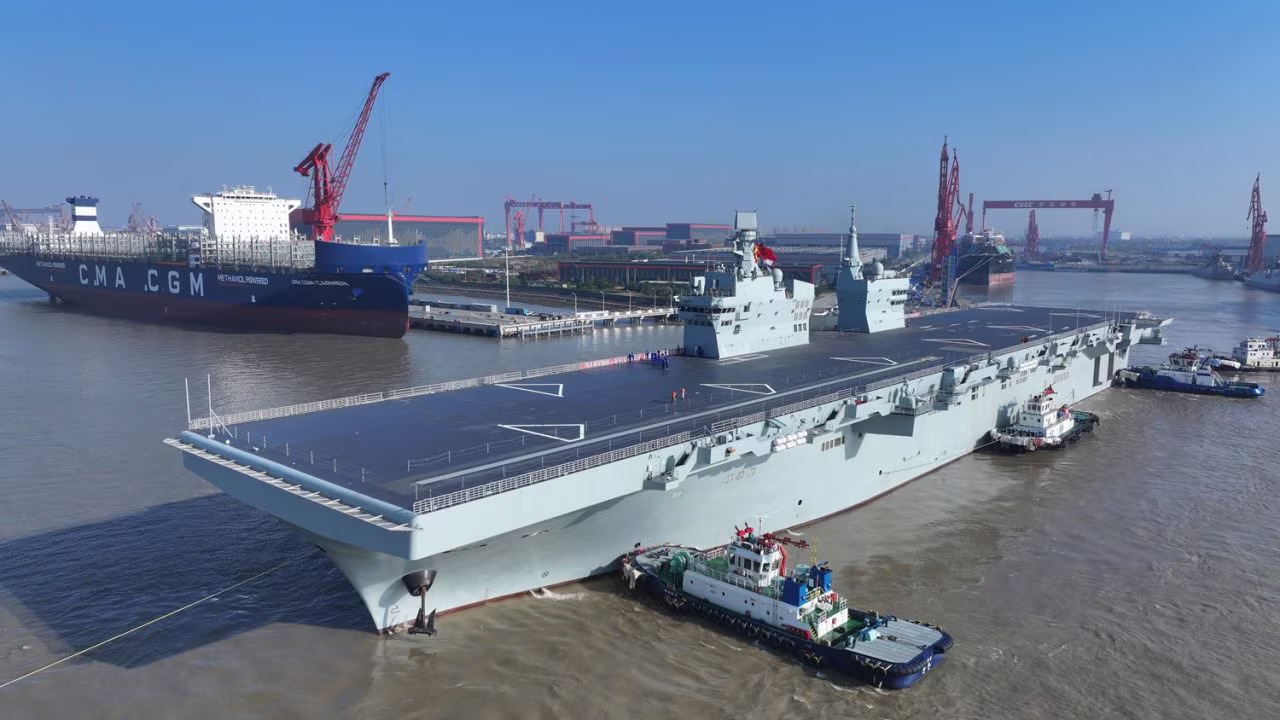
China has dispatched its first Type 076 amphibious assault ship, the Sichuan (Hull 51), for initial sea trials from the Hudong Zhonghua shipyard in Shanghai, only days after commissioning the nation’s newest aircraft carrier, Fujian. The back-to-back debuts of two next-generation capital ships underscore the accelerating expansion of the People’s Liberation Army Navy (PLAN) and its move toward integrating amphibious lift, carrier aviation, and unmanned combat mass into a single operational system.
Sichuan Begins Testing in Yangtze Estuary
The 40,000-ton Type 076, widely described by Chinese media as the world’s first “drone carrier”, departed the shipyard to begin propulsion, electrical load, and seakeeping tests in the Yangtze River estuary. Early phases will verify the performance of the newly designed integrated electric propulsion system, a critical component required to power the ship’s headline feature—the Electromagnetic Aircraft Launch System (EMALS)—before aviation trials begin later in the same waters used for the Type 075 program.
High-resolution imagery released by Chinese outlets shows the vessel maneuvering under its own power, marking a significant milestone for the PLAN’s most ambitious amphibious ship yet.
A Hybrid Amphibious–Carrier Platform
The Type 076’s design positions it between China’s Type 075 landing helicopter docks and its full-sized aircraft carriers. Open-source assessments place the ship at around 260 meters in length, with a broad, straight flight deck approximately 50 meters wide—dimensions approaching those of the U.S. Navy’s Wasp- and America-class amphibious assault ships.
A distinctive twin-island configuration separates navigation functions from aviation and combat operations. Compared with the earlier Type 075, the deck area appears extended to accommodate more intense aircraft and drone launch cycles.
Beneath the deck, the ship retains its amphibious core, including a well deck for landing craft and armored vehicles. Internal spaces are believed to support brigade-level troop deployments, although no official figures have been released.
First Amphibious Ship Equipped With EMALS
The standout feature of the Type 076 is the installation of an Electromagnetic Aircraft Launch System (EMALS)—a first for any amphibious assault ship worldwide. Imagery published in Chinese state media confirms the presence of at least one long catapult trench, estimated at roughly 130 meters in length.
The integration of EMALS requires exceptionally stable electrical output, which explains why initial trials emphasize power generation and distribution. If validated, this technology would allow the ship to launch heavier unmanned aircraft and potentially even crewed fixed-wing aircraft, dramatically expanding its operational envelope beyond traditional helicopter operations.
Drone-Centric Air Wing Expected
Chinese defense outlets consistently refer to the Type 076 as a dedicated drone platform, and sources linked to the defense industry highlight several systems expected to form its air wing:
-
GJ-11 Sharp Sword stealth UCAVs
-
Long-endurance reconnaissance UAVs
-
Rotary-wing unmanned systems for ISR, targeting, and resupply
-
Standard shipborne helicopters for troop lift, ASW, and SAR
If EMALS tests are successful, analysts say the ship could support limited operations of the J-35 stealth carrier fighter, adding air-defense and strike options to its mission set.
Early imagery shows the vessel outfitted with HHQ-10 short-range missile launchers and Type 1130 CIWS, forming a layered defensive suite intended to counter cruise missiles and low-flying threats.
Strategic Implications for Taiwan and the First Island Chain
With Sichuan now at sea, military planners in the region are reassessing the operational impact of a vessel that merges amphibious warfare, carrier aviation and unmanned mass. In a Taiwan contingency, the Type 076 could serve as a forward aviation and drone operations hub, launching UCAVs to probe air defenses, conducting persistent ISR missions and coordinating long-range strikes while remaining beyond the densest missile engagement zones.
The ship’s amphibious capacity allows it to deploy marines and armored vehicles once an operational window opens, while its air assets provide cover, reconnaissance and strike support.
Across the first island chain, the vessel could function as a mobile command-and-control node, integrating data from drones, satellites and surface combatants to enhance the PLAN’s maritime situational awareness and targeting networks.
Peacetime Roles and Regional Influence
Outside high-end conflict, the Type 076 gives Beijing a highly flexible platform for South China Sea patrols, humanitarian missions, non-combatant evacuations and grey-zone operations around disputed features. Its ability to embark varied mixes of marines, helicopters and UAVs makes it suitable for both crisis response and coercive presence missions.
For China’s defense industry, Sichuan also demonstrates growing expertise in integrated electric propulsion, large composite structures and high-energy electromagnetic systems—capabilities that will support future carrier and surface combatant programs.
A New Chapter in PLAN Expansion
As Sichuan proceeds through its first trial phase and prepares for more advanced aviation tests later this year, analysts say the ship represents not just a new hull, but a new concept in Chinese maritime power. By blending amphibious lift, EMALS-enabled aviation and drone mass on a single platform, the Type 076 signals a shift in how the PLAN intends to project force in the coming decade.
With full operational capability expected around 2026, Sichuan’s entry into service is likely to reshape naval calculations across East Asia—adding a new dimension to China’s growing ability to conduct sustained maritime operations near Taiwan and throughout the Indo-Pacific.
About the Author
Aditya Kumar:
Defense & Geopolitics Analyst
Aditya Kumar tracks military developments in South Asia, specializing in Indian missile technology and naval strategy.