China Reportedly Helps Belarus Launch Massive Artillery Shell Production, With Output Flowing to Russia
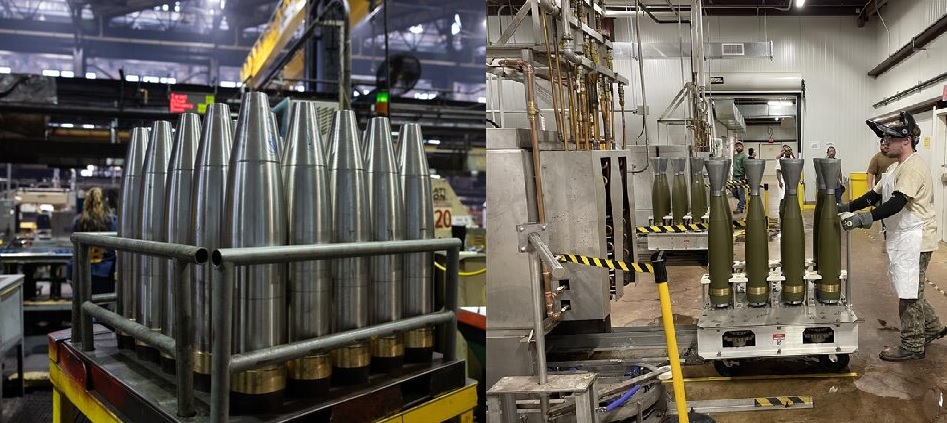
Belarus has quietly emerged as a major ammunition-casing manufacturer for Russia, after establishing large-scale production lines with direct Chinese assistance. According to reports cited by Deutsche Welle, China supplied the Belarusian government with specialized machinery capable of producing casings for 152-mm artillery shells and 122-mm GRAD rockets, enabling an annual output of nearly half a million units at a single enterprise.
Investigators say the new Belarusian facility produces around 240,000 artillery-shell casings and 240,000 MLRS rocket bodies each year. These are not complete munitions but metallic blanks, which are then exported to Russia. Russian factories later fill them with explosives, install fuses, and complete the final assembly — a division of labor that significantly accelerates Moscow’s ammunition production cycle. Chinese engineers reportedly helped set up the machinery and remain involved in overseeing operations on-site.
The expansion of Belarus’s defense-industrial capacity comes at a critical time for Russia, whose artillery-dependent war effort in Ukraine has strained its domestic ammunition industry. By absorbing the labor-intensive metal-forming phase of production, Belarus enables Russian factories to focus on explosive filling and rapid assembly, effectively removing one of Moscow’s major bottlenecks. Analysts note that this arrangement helps Russia maintain high-volume artillery fire, a central component of its battlefield strategy.
Belarus’s growing role extends beyond the 152-mm and 122-mm lines. Sources familiar with the sector indicate that Minsk is also expanding production of 82-mm and 120-mm mortar shell bodies, tank-ammunition casings, additional MLRS components, and propellant-related metal housings. Once fully scaled, Belarus could surpass 700,000 ammunition-component blanks per year, making it one of the largest indirect contributors to Russia’s wartime supply chain.
The Chinese role in the process has raised political concerns in Europe and the United States. Although Beijing denies supplying lethal aid to Russia, Western intelligence agencies say China has exported machine tools, metal-forming systems, industrial furnaces, and inspection robots — all critical for ammunition production — to Belarusian plants supporting Russia. China’s deployment of engineers has intensified scrutiny, with officials arguing that this assistance effectively constitutes indirect military support for Moscow.
For Belarus, participation in Russia’s ammunition supply chain strengthens its strategic importance to the Kremlin but risks greater international isolation and future sanctions. For Russia, the arrangement ensures a steady supply of essential components while relieving pressure on its own sanctions-affected factories. For Western nations, the development poses a fresh challenge to efforts aimed at restricting Russia’s capacity to sustain its war in Ukraine.
With Russia continuing high-intensity operations, the new Belarusian production lines provide Moscow with a critical industrial cushion — one that could shape the tempo and duration of the conflict in the months and years to come.
About the Author
Aditya Kumar:
Defense & Geopolitics Analyst
Aditya Kumar tracks military developments in South Asia, specializing in Indian missile technology and naval strategy.