China Quietly Building Nuclear Attack Resistant 78,000-Tonne Floating Artificial Island in Ocean
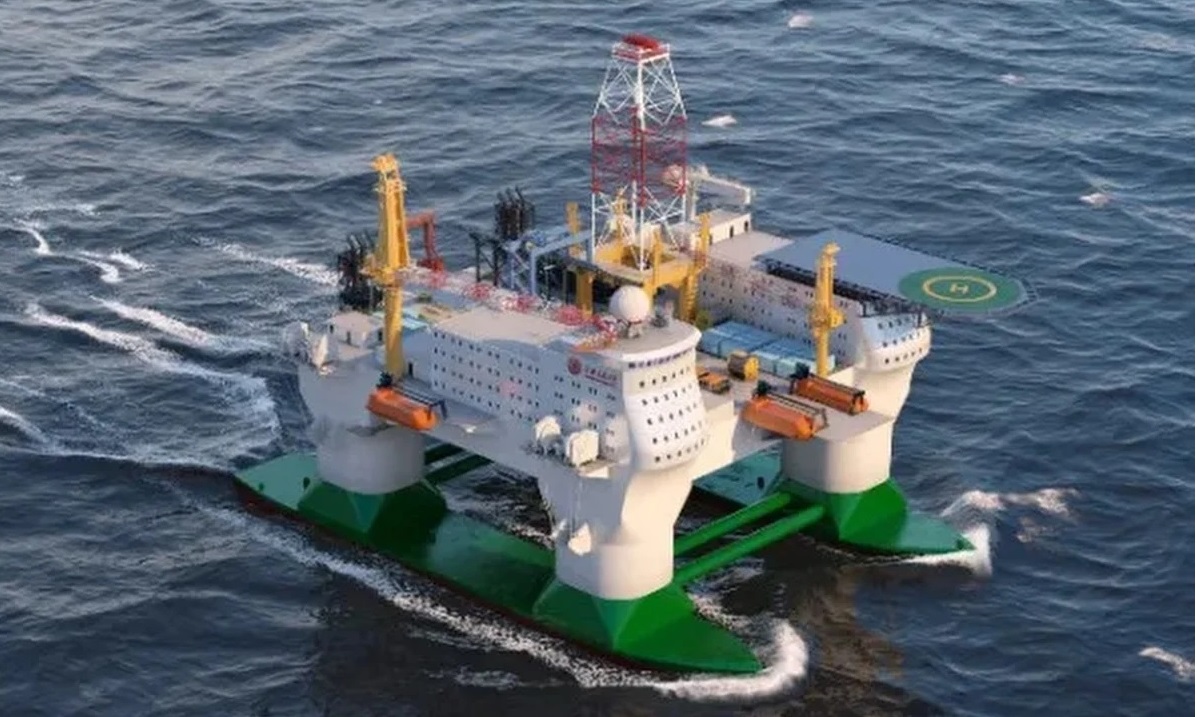
China is quietly constructing one of the most extraordinary maritime structures ever attempted: a mobile, nuclear-blast-resistant floating artificial island, a 78,000-tonne semi-submersible platform capable of surviving super-typhoons, operating for months without resupply, and hosting nearly 240 people in the middle of the ocean.
Behind its official label as a “deep-sea research facility,” international analysts see something far more consequential — a new kind of mobile sea base that could change the future of maritime power.
A Research Platform That Looks a Lot Like a War Asset
The project, officially named the Deep-Sea All-Weather Resident Floating Research Facility, was approved as a major national science infrastructure in China’s 14th Five-Year Plan. Its builders describe it as the world’s first self-sustaining, mobile artificial island, one that can operate continuously for 120 days while cruising at 15 knots.
Its displacement rivals the PLA Navy’s newest aircraft carrier Fujian, and its dimensions — 138 meters long, 85 meters wide, with a 45-meter-high main deck — put it in the class of large naval vessels rather than research barges.
Yet what truly sets it apart is something no science facility has ever needed before: nuclear blast protection.
Why Would a Scientific Platform Need to Survive a Nuclear Explosion?
A paper published on November 4 in the Chinese Journal of Ship Research, led by Professor Yang Deqing of Shanghai Jiao Tong University, reveals the surprising answer.
The platform’s superstructure houses the rooms that keep the island alive: emergency power, navigation controls, and long-distance communications. If those fail, the entire platform — and its 238 residents — would be adrift. Yang’s team wrote that these core compartments needed to survive “the worst-case scenario,” including a nuclear shockwave.
The design team therefore turned to a military nuclear-blast standard, GJB 1060.1-1991 — an unusual reference for a civilian science project.
A Metamaterial “Sandwich” That Turns a Nuclear Shock Into a Gentle Push
Traditional nuclear-resistant armour requires steel plates so thick they would cripple the platform’s buoyancy and internal space. Yang’s team instead created a metamaterial sandwich bulkhead — a three-dimensional lattice of corrugated metal tubes with a “negative Poisson’s ratio.”
In simple terms, when this material is hit by a shockwave, it contracts inward and absorbs the blast instead of snapping outward like normal metal. Under nuclear-level overpressure, computer simulations showed:
-
58% less deformation
-
14% lower peak stress
-
No permanent structural damage
-
A protective bulkhead just 60 mm thick — slimmer than a smartphone
The researchers call this effect “quasi-static conversion” — transforming a violent, instantaneous nuclear shock into a slow, steady squeeze.
In tests, this metamaterial armor outperformed much heavier steel plates while weighing slightly less, solving a decades-old engineering problem: how to survive a nuclear blast without sinking your own ship.
A Mobile Island Built for Tempestuous Seas — and Even More Tempestuous Politics
What China has engineered here is not just a piece of scientific hardware; it is a floating statement of intent. Its semi-submersible twin-hull design gives it the poise of a fortress at sea, steady even in sea state 7, when waves tower 6 to 9 meters high. Engineers even claim it can ride out Category-17 typhoons — storms so violent that most ships would flee long before they arrive.
But its real power lies not in what it can endure, but in where it can go. Unlike the concrete islands Beijing built in the South China Sea — which draw diplomatic fire every time they expand — this platform leaves no permanent footprint. It can quietly appear in a disputed region, linger for months thanks to its four-month endurance, and vanish just as easily when the political weather turns foul.
It is, at its core, a strategic ghost: not quite a warship, not quite a territorial claim, but undeniably capable of serving as both when needed. Its mobility gives China a way to maintain presence without planting a flag, and its endurance allows it to wait out political storms just as it waits out typhoons on the open sea.
Official Science Mission — and the Unmistakable Strategic Shadow Behind It
Beijing insists the platform is destined for peaceful, scientific pursuits. On paper, it is a dream for oceanographers: a drifting laboratory for deep-sea environmental monitoring, long-duration climate research, seabed mineral exploration, and extensive testing of autonomous underwater vehicles. It fits neatly into China’s narrative of expanding its “blue economy”, a future built on underwater robotics, sustainable energy, and new discoveries in the deep.
Yet even the most generous observers acknowledge there is more at play here.
When a structure can withstand a nuclear shockwave, shelter hundreds of personnel, stay operational for 120 days, and carry enough equipment to function as a surveillance outpost or a floating command centre, it becomes something far larger than a research platform.
In the eyes of many defence analysts, this isn’t just a lab — it’s a mobile forward operating base, wrapped in the language of science.
And because it flies a civilian banner, it operates in a legal grey zone that warships cannot occupy.
This dual identity — peaceful in appearance, powerful in capability — is exactly what makes China’s floating island so strategically unsettling. It is a vessel designed for discovery, yes, but also for deterrence, presence, and persistence in waters where Beijing’s ambitions run deepest.
A Strategic Tool for Contested Seas
The platform could appear in disputed zones like the South China Sea, offering China constant presence without the diplomatic fallout of building permanent islands. It could also support long-duration mapping, intelligence gathering, or logistics for unmanned fleets — capabilities that are increasingly central to modern naval strategy.
Some analysts warn it could become a mobile intelligence hub, a deep-sea mining outpost, or even a dispersed command center hardened against nuclear or EMP attacks.
Its endurance — even greater than some nuclear-powered carriers — makes it ideal for remote ocean basins far from the Chinese mainland.
A Race Against Time — and Rival Powers
Project leader Lin Zhongqin said China is “racing to complete construction” by 2028, pushing shipyards, designers, and material scientists to work in parallel.
The platform emerges just as the U.S. resumes its own nuclear weapons testing, ending a 33-year moratorium and adding urgency to China’s nuclear-resistant engineering efforts.
Globally, the development may accelerate the maritime power race, inspiring:
-
U.S. interest in mobile forward operating bases,
-
regional concerns among Southeast Asian nations,
-
and scientific debate over the militarization of ocean research.
Conclusion: The Birth of a New Class of Sea Power
China’s nuclear-resistant floating artificial island is more than a science project. It marks the arrival of a new maritime concept: a mobile fortress-laboratory hybrid, able to survive nuclear shockwaves, ride out super-storms, and sustain long-term missions deep in contested waters.
If launched as planned in 2028, it could redefine ocean research, reshape regional power dynamics, and signal the beginning of a future where floating megastructures — not just warships — become instruments of global influence.
About the Author
Aditya Kumar:
Defense & Geopolitics Analyst
Aditya Kumar tracks military developments in South Asia, specializing in Indian missile technology and naval strategy.
Top 6 Latest Posts



Leave a Comment: Don't Wast Time to Posting URLs in Comment Box

2025-11-23 00:06:18
"Nuclear blast-resistant" sounds great! Just like "iron dome".
