China Analysts Say China Could Match US in Military Conflict Thanks to Shipbuilding Strength
China's robust shipbuilding capabilities may enable it to match the US in a military conflict, thanks to rapid production and repair rates, strategic positioning, and advanced naval technology.
China's rapid naval expansion and robust shipbuilding capabilities have positioned the People's Liberation Army (PLA) to potentially match the United States in a military conflict, according to analysts. Raymond Kuo, director of the Rand Corporation’s Taiwan Initiative, emphasized that China's shipbuilding industry, alongside those of Japan and South Korea, is among the largest in the world. This allows China to produce completed naval hulls more quickly than the US, giving it a strategic edge in reconstituting combat losses.
While US naval ships are generally more complex and have greater displacement, China’s faster production rate of naval ships means it can repair or replace damaged vessels more swiftly. This capability is particularly advantageous in conflicts near China's shores, such as over Taiwan or in the South China Sea.
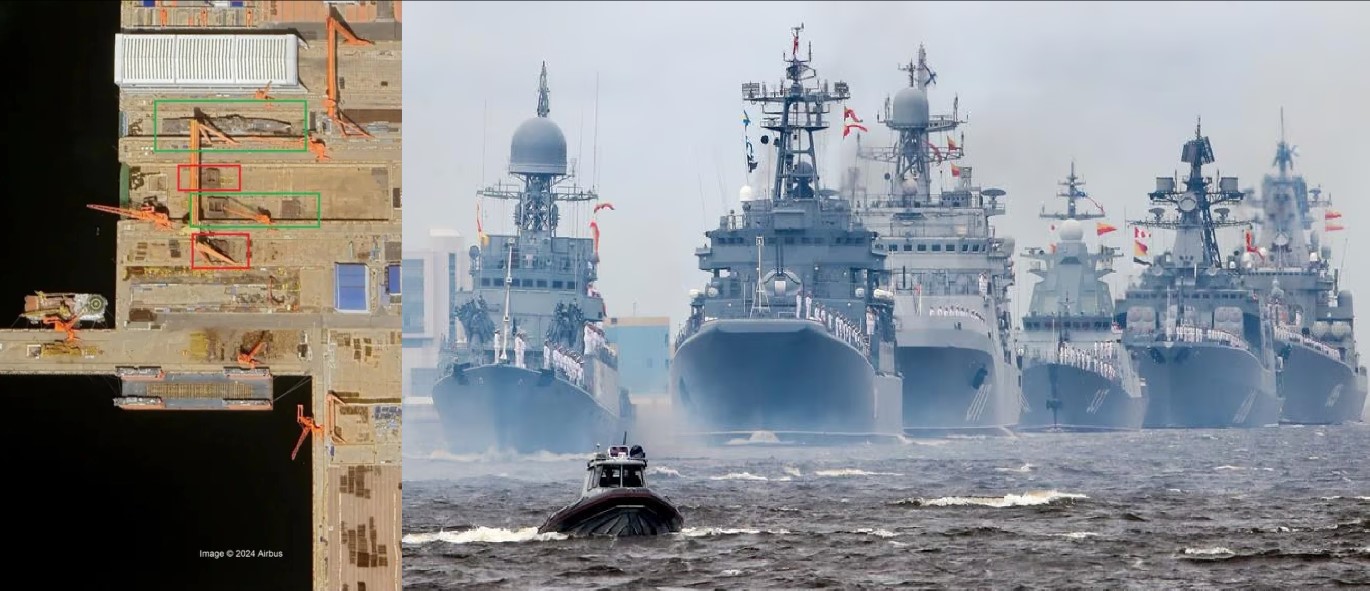
A recent analysis of satellite imagery by Naval News revealed that China has launched its 10th Type 055 destroyer, the country's most advanced warship designed to escort aircraft carriers. Since the first Type 055 was commissioned in 2020, eight ships are already in service, with the ninth launched late last year. The same shipyard has also launched five Type 052 destroyers and carried out modernization work on the Liaoning, China’s first aircraft carrier.
A report from the Centre for Strategic and International Studies (CSIS) highlighted that China’s massive shipbuilding industry would provide a strategic advantage in a prolonged conflict. In contrast, the US faces significant maintenance backlogs and would struggle to quickly construct or repair warships in a major conflict.
The timing of China’s naval advancements coincides with increased US efforts to develop a drone strategy aimed at countering a potential Chinese attack on Taiwan. Admiral Samuel Paparo, commander of the US Indo-Pacific Command, outlined plans for a large, lethal drone force to create a “hellscape” in the Taiwan Strait, buying time for the US to defend the island.
However, Collin Koh from the S. Rajaratnam School of International Studies noted that the US would need to neutralize China's ability to project force on Taiwan and sustain a war. This would involve destroying Chinese shipyards and investing in long-range precision-guided munitions, such as cruise missiles.
Malcolm Davis, a senior analyst at the Australian Strategic Policy Institute, pointed out that the US would need to reverse its declining shipbuilding capability to effectively counter China. The US Naval Institute reported that the US has just seven shipyards capable of building large warships, compared to over 20 in China.
China's Type 055 destroyer, also known as a missile cruiser, is a testament to its advanced naval capabilities. The ship measures 180 meters in length, has a beam of 20 meters, and a displacement of around 13,000 tonnes. It features 112 vertical launch system cells for housing and firing missiles, including the HHQ-9 long-range surface-to-air missiles and the YJ-18 anti-ship missiles. In 2022, footage showed a Type 055 test-firing China’s latest hypersonic anti-ship missile, the YJ-21.
Despite China's advancements, questions remain about the sustainability of its naval fleet given the country's current economic issues. Nonetheless, the import and indigenization of foreign technology have matured Chinese shipyards, enabling the PLA Navy to deploy advanced destroyers with greater regularity.
✍️ This article is written by the team of The Defense News.