Canada Turns to China, Scraps 100% EV Tariff as U.S. Trade Risks Mount
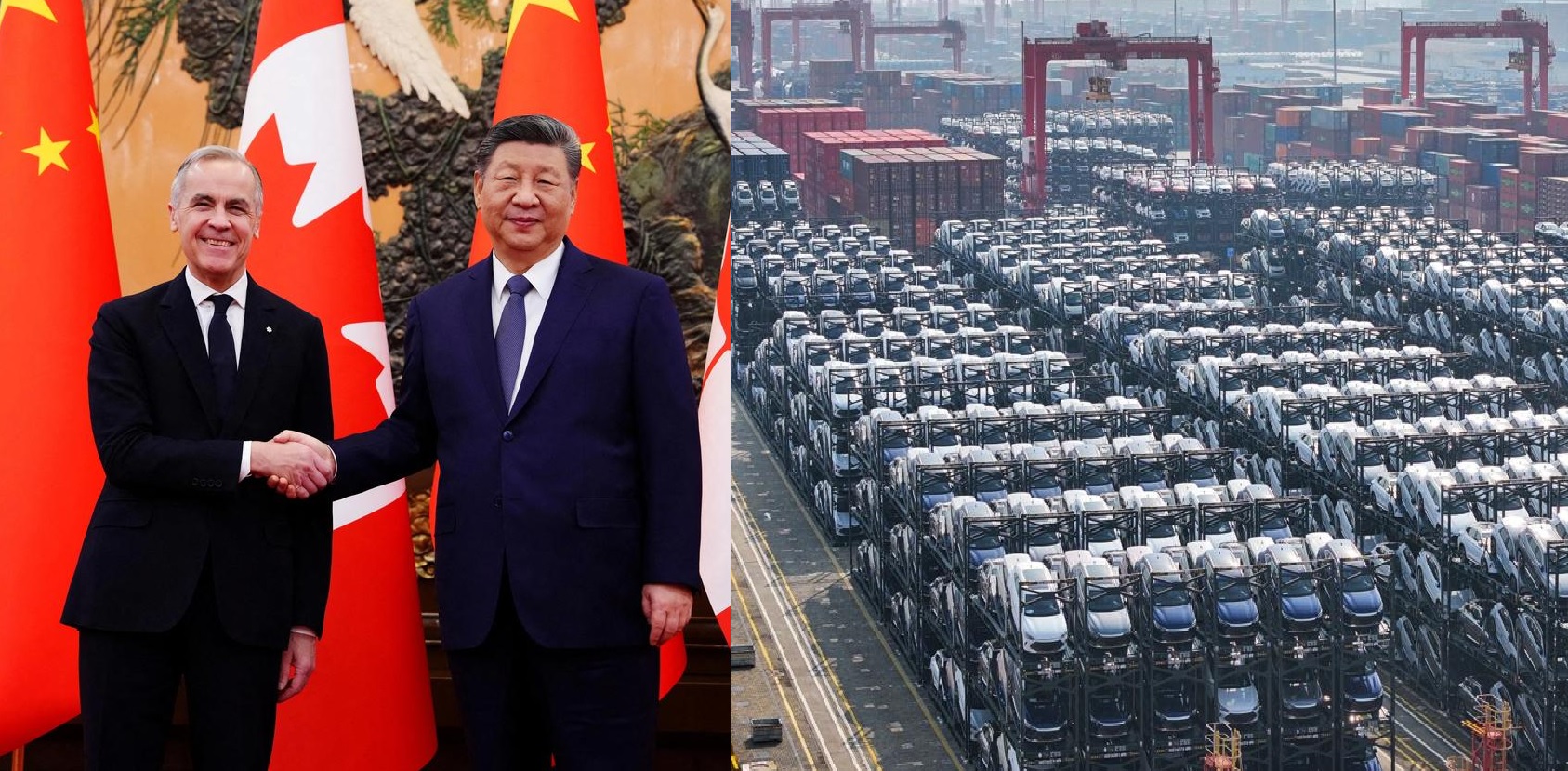
Ottawa / Beijing :Canada has formally dismantled one of its most aggressive trade barriers against China, agreeing to lift a 100 percent punitive tariff on Chinese electric vehicles (EVs) in exchange for sharply reduced duties on Canadian agricultural exports, in a move that signals a major recalibration of Ottawa’s economic strategy amid renewed uncertainty in its relationship with the United States.
The decision, announced during Prime Minister Mark Carney’s high-profile visit to Beijing, replaces the blanket tariff with a controlled quota system. Under the new framework, the first 49,000 Chinese EVs entering Canada annually will be taxed at the standard 6.1 percent most-favored-nation rate, with gradual increases and volume caps phased in over the next five years. The agreement also includes the rollback of steep Chinese tariffs on Canadian farm goods, most notably canola, restoring access to one of Canada’s most lucrative export markets.
The shift marks a dramatic reversal of policies imposed in 2024 under the previous Liberal government, which had levied the EV tariff—along with a 25 percent duty on Chinese steel and aluminum—to align closely with U.S. trade restrictions aimed at curbing China’s industrial expansion.
A Strategic Pivot Toward Beijing
Alongside the tariff rollback, Canada and China signed a China–Canada Economic and Trade Cooperation Roadmap, outlining plans to deepen bilateral commerce in agriculture, clean technology, critical minerals, and supply-chain coordination. Canadian officials described the agreement as a “stabilization mechanism” after years of diplomatic strain that followed Beijing’s detention of two Canadians in 2018 in retaliation for Canada’s arrest of a Huawei executive.
Trade analysts say the deal reflects a growing perception in Canada that economic risks from Washington now outweigh those posed by Beijing. Edward Alden, a senior fellow at the Council on Foreign Relations, noted that Trump-era protectionism has fundamentally altered Ottawa’s calculus. “For many Canadians, the United States has become the less predictable partner,” Alden said, adding that China is increasingly viewed as a market Canada cannot afford to abandon.
Trump’s Shadow Over Ottawa
The agreement lands at a delicate moment in North American trade politics. Since returning to office in January, Donald Trump has revived his hardline tariff agenda, imposing sweeping import taxes across multiple sectors and threatening allies and rivals alike with retaliatory measures.
Canada has repeatedly found itself in Trump’s crosshairs. Last autumn, the U.S. president threatened a 10 percent tariff on Canadian goods following a political advertisement aired by Ontario’s provincial government. While that threat was never carried out, existing U.S. tariffs on Canadian steel and aluminum remain in force.
Analysts now warn that Ottawa’s overture to Beijing could provoke a fresh response from Washington, particularly with the United States–Mexico–Canada Agreement (USMCA) scheduled for review and renewal later this year. Automotive manufacturing, one of the most integrated sectors across the U.S.-Canada border, is widely seen as the most vulnerable target.
Farmers Gain, Auto Sector Braces
For Canadian farmers, the benefits of the China deal are immediate and tangible. Beijing has agreed to slash tariffs on canola from 84 percent to 15 percent, reopening a market worth billions of dollars annually. Agricultural exporters also secured improved access for pork, barley, and peas, sectors that have struggled to diversify beyond China and the U.S.
The domestic reaction, however, has been sharply divided. Ontario Premier Doug Ford condemned the agreement, warning that an influx of low-cost Chinese EVs could undercut Canadian auto workers and jeopardize access to the U.S. market. “You don’t protect Canadian jobs by opening the floodgates,” Ford said, calling the policy a strategic gamble with long-term consequences.
Carney has pushed back against those concerns, emphasizing that the quota system strictly limits imports and that safeguards are built in to protect domestic manufacturers. “This is not an open-door policy,” he said, describing the agreement as a controlled and reversible step rather than a wholesale shift.
A Global Search for Alternatives to the U.S.
Canada is not alone in reassessing its trade dependencies. The European Union is close to finalizing a long-delayed agreement with the Mercosur bloc, linking it more closely with Brazil and Argentina, while simultaneously pursuing a separate deal with India.
China, meanwhile, has accelerated its export diversification strategy. Despite sustained U.S. tariffs, Beijing’s trade surplus reached a record $1.2 trillion last year, driven by stronger sales to Europe and Southeast Asia. The approach has allowed China to blunt the impact of American restrictions while deepening ties with middle powers such as Canada.
Calculated Risk Ahead
Carney’s move carries undeniable political and economic risks, particularly as Canada prepares for high-stakes USMCA negotiations. Yet the prime minister appears to be betting that U.S. manufacturers, deeply reliant on cross-border supply chains, will lobby against harsh retaliation.
Trump, for his part, has offered mixed signals. While his administration has not ruled out countermeasures, the president has publicly praised Carney as a “smart negotiator,” suggesting that any response may be calibrated rather than immediate.
For Canada, the agreement underscores a broader reality: in an era of unpredictable U.S. trade policy, Ottawa is increasingly willing to hedge its bets. Whether that strategy strengthens Canada’s hand—or exposes it to new vulnerabilities—may soon be tested on both sides of the Pacific.
About the Author
Aditya Kumar:
Defense & Geopolitics Analyst
Aditya Kumar tracks military developments in South Asia, specializing in Indian missile technology and naval strategy.