CRS Flags Key Risks as Congress Reviews U.S Navy’s Trump-Class Guided-Missile Battleship Plan
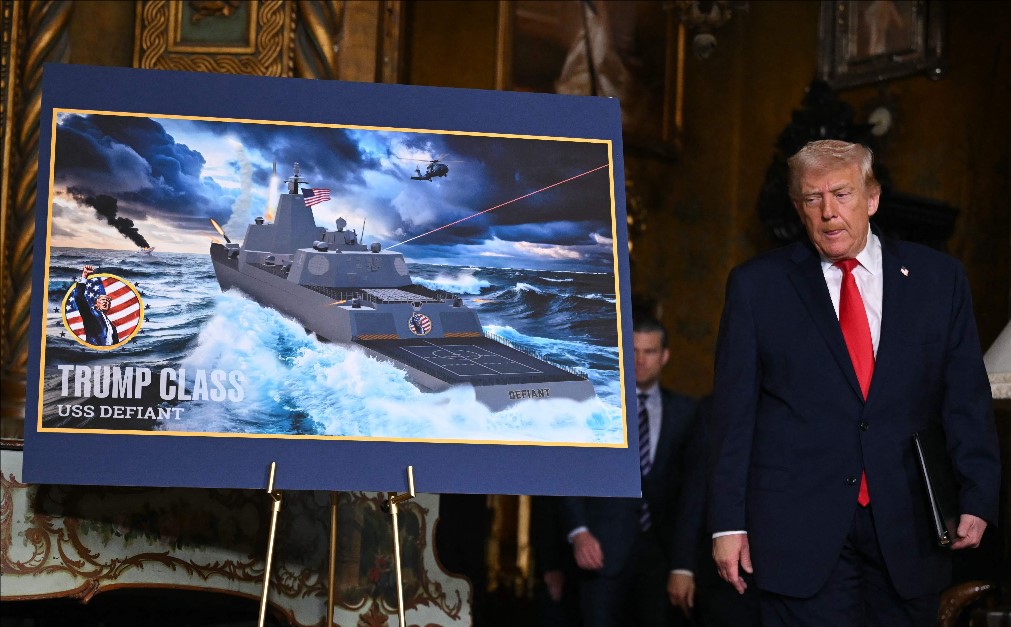
Washington, D.C : A newly released report by the Congressional Research Service (CRS) has brought renewed attention to one of the most ambitious and contentious naval proposals in decades: the U.S. Navy’s plan to build new Trump-class guided-missile battleships, the first since the end of the Second World War.
The report, titled Navy Guided Missile Battleship (BBG[X]) Program: Background and Issues for Congress, was published on December 30, 2025, and is intended to brief lawmakers ahead of upcoming defence budget deliberations and scrutiny of the Navy’s long-term shipbuilding plans. While the CRS stops short of endorsing the programme, it lays out the strategic rationale, technical ambitions and unresolved questions surrounding the proposed BBG(X) class.
According to the report, the Navy envisions BBG(X) as a new category of large surface combatant, significantly exceeding the size and firepower of today’s cruisers and destroyers. The ships would form the centrepiece of a broader “Golden Fleet” concept aimed at expanding and recapitalising the U.S. surface force amid intensifying great-power naval competition.
A Battleship for the Missile Age
CRS notes that the lead ship of the class, reportedly to be named USS Defiant, is expected to be ordered in the early 2030s, with entry into operational service projected for the late 2030s or around 2040. The Navy has already initiated the design phase, issuing contract notices for six years of preliminary and detailed design work late in 2025.
Preliminary specifications outlined in the report describe a vessel approximately 840 to 880 feet in length, with a displacement exceeding 35,000 tonnes. That would make BBG(X) substantially larger than the Arleigh Burke-class (DDG-51) destroyers that currently form the backbone of the surface fleet.
The proposed battleships are intended to carry an exceptionally heavy weapons load. CRS references Navy and administration statements pointing to future integration of hypersonic missiles, large numbers of vertical launch system (VLS) cells, and emerging technologies such as electromagnetic railguns and high-energy laser weapons. However, the report stresses that several of these systems remain in development and may not be mature when construction decisions are required.
Administration Backing And Political Overtones
The BBG(X) concept received high-profile backing in a December 2025 Department of War press release, in which Donald J. Trump and senior defence officials described the ships as the largest, most lethal and most versatile warships ever planned by the U.S. Navy. The administration outlined a long-term vision for a fleet of 20 to 25 battleships, informally dubbed the Trump-class, to be built entirely in American shipyards.
Officials argued that the programme would not only enhance U.S. naval firepower but also revitalise domestic shipbuilding capacity and skilled industrial employment. CRS, however, cautions that such ambitions would place significant strain on an already stretched shipbuilding industrial base.
Key Questions for Congress
Rather than advocating a specific policy outcome, the CRS report frames a series of critical issues for lawmakers. Central among them is the fundamental question of why battleships are needed in the 21st century, particularly as U.S. naval doctrine has increasingly emphasised distributed maritime operations, networked forces and survivability through dispersion rather than concentration.
The report also highlights concerns over cost and opportunity trade-offs. While no official cost figures have been released, CRS notes that ships of this size and complexity could each cost well into the tens of billions of dollars, raising questions about their affordability relative to other priorities, including submarines, unmanned systems and the next-generation DDG(X) destroyer programme.
Another issue flagged by CRS is whether the BBG(X) proposal has been informed by a sufficiently robust analysis of alternatives, including smaller or more numerous platforms capable of delivering similar missile firepower at lower risk and cost.
Debate Intensifies
The battleship proposal has already sparked debate among defence analysts and legislators. Supporters argue that a heavily armed, resilient surface platform could provide unmatched strike capacity, command-and-control capabilities and deterrent value. Critics counter that large surface combatants may be increasingly vulnerable in high-end conflicts dominated by long-range precision weapons.
As Congress prepares to review the Navy’s 30-year shipbuilding plan in the coming months, the CRS report is set to play a central role in shaping deliberations. Whether BBG(X) emerges as a cornerstone of future U.S. naval power or a cautionary example of overreach will depend on decisions now facing lawmakers — decisions that could define the character of the U.S. Navy well into the middle of the century.
About the Author
Aditya Kumar:
Defense & Geopolitics Analyst
Aditya Kumar tracks military developments in South Asia, specializing in Indian missile technology and naval strategy.