Boeing and RAAF Achieve Historic In-Flight Control of MQ-28 Ghost Bats from E-7A Wedgetail
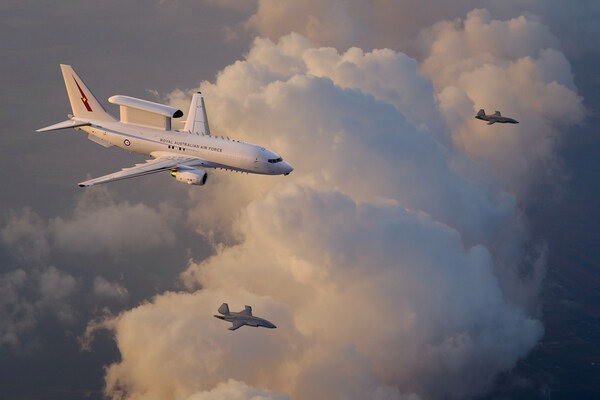
In a major milestone for modern air combat technology, Boeing and the Royal Australian Air Force (RAAF) have successfully carried out a groundbreaking mission by controlling multiple uncrewed MQ-28 Ghost Bat aircraft from an airborne E-7A Wedgetail command aircraft. This is the first time in history that such a mission has been achieved, marking a new chapter in airborne warfare and the use of advanced unmanned systems alongside crewed aircraft.
What Happened?
During this landmark mission, two operational MQ-28 Ghost Bat drones and one digital (virtual) aircraft were remotely controlled from a single E-7A Wedgetail in the air. An operator sitting inside the Wedgetail managed the drones, simulating their role in protecting and supporting manned aircraft during missions.
This demonstration was part of Capability Demonstration 2025 (CD25) — a series of planned events by the RAAF to test and showcase the operational capabilities of the MQ-28 and its integration with other combat aircraft like the F/A-18F Super Hornet and F-35 Lightning II in the future.
Why Is This Important?
This successful mission proves that advanced uncrewed aircraft like the MQ-28 can be effectively operated from airborne control platforms like the E-7A Wedgetail. It highlights how future air forces can use a combination of manned and unmanned aircraft working together, creating what experts call a "family-of-systems". This approach increases battlefield awareness, improves decision-making, and enhances combat power while reducing risks to human pilots.
As Glen Ferguson, director of MQ-28 Global Programs, explained:
"It validated a key element of the MQ-28’s operational concept — showing how collaborative combat aircraft can extend and enhance the role of the E-7A Wedgetail to meet future military needs."
Australian Defence Industry Minister Pat Conroy also praised the achievement, calling the Ghost Bat a potential game-changer.
"The Ghost Bat can turn a single fighter jet into a fighting team, with its advanced sensors acting like hundreds of eyes in the sky," he said.
About the MQ-28 Ghost Bat
The MQ-28 Ghost Bat is Australia’s first indigenously designed combat drone and a key part of the country’s future air defence plans. Developed by Boeing Australia, it’s designed to fly alongside crewed fighter jets and other assets, carrying out missions such as reconnaissance, surveillance, and even electronic warfare.
Key Features of MQ-28 Ghost Bat:
-
Length: 11.7 meters
-
Wingspan: 7.3 meters
-
Range: Over 3,700 kilometers
-
Speed: Subsonic
-
Modular Nose: Can carry different mission systems including radar, sensors, and electronic warfare equipment
-
Autonomous Capabilities: Can operate independently or in coordination with manned aircraft
The drone is equipped with advanced sensors and artificial intelligence systems, allowing it to detect threats, gather information, and provide crucial battlefield awareness to its operators.
About the E-7A Wedgetail
The E-7A Wedgetail is a high-performance airborne early warning and control (AEW&C) aircraft. Based on the Boeing 737 airliner, it features a powerful radar mounted on top of the fuselage, giving it 360-degree coverage. It serves as a flying command and control centre, managing air operations over a wide area.
Key Features of E-7A Wedgetail:
-
Radar Range: Over 400 kilometers
-
Operational Crew: Typically 6–10 operators managing radar, communications, and combat data
-
Primary Role: Airborne surveillance, command, and control
What’s Next?
This successful demonstration is just the beginning. As part of Capability Demonstration 2025, more complex missions involving Ghost Bats and manned fighters like the F-35 and F/A-18F Super Hornet are planned. These missions will further test the drones’ ability to work alongside human pilots, expanding the reach and effectiveness of Australia’s air combat forces.
As Boeing’s Adam Tsacoumangos noted,
"It has been an exceptional collaborative effort between governments, contractors, and international partners."
This trial not only marks a major step in the evolution of unmanned systems but also confirms that the future of air combat will be a seamless blend of human and machine working together in the sky.
✍️ This article is written by the team of The Defense News.