BlackSky Displays Gen-3 Satellite Tracking of F-35 Formation in Real Time at Dubai Airshow
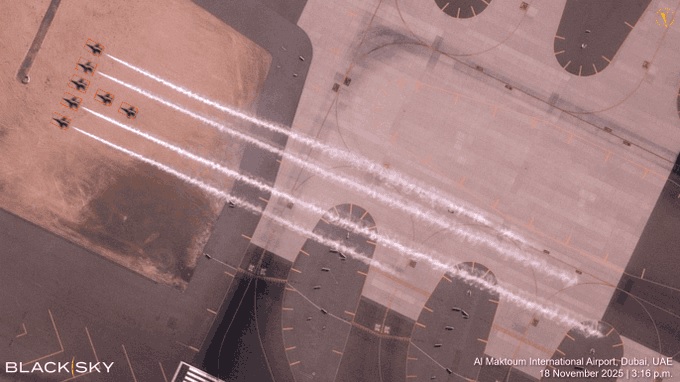
The skies above the Dubai Airshow briefly became a showcase not only for cutting-edge fighter jets but also for the next generation of space-based intelligence. As a formation of F-35 stealth fighters roared through their aerial display, U.S.-based satellite firm BlackSky quietly captured the moment from orbit — and analysed it within minutes.
The company later revealed that its Gen-3 satellite constellation, equipped with advanced AI analytics, had automatically detected each aircraft in the formation. The demonstration, they said, was more than a photo; it was proof of real-time intelligence from space, the kind of capability defence forces increasingly rely on for rapid situational awareness.
A Constellation Built for Speed and Precision
The Gen-3 satellites are designed with a simple philosophy: time is the most important commodity in modern warfare. According to BlackSky, the constellation combines hourly revisit rates, 35 cm high-resolution imagery, NIIRS-5+ clarity, and AI-powered interpretation. It allows intelligence teams to see — and understand — changes on the ground almost as soon as they happen.
From the moment a satellite captures an image, BlackSky’s system can deliver processed intelligence in about 60 minutes, a pace they argue gives military commanders the ability to respond before opportunities fade.
At present, 16 Gen-3 satellites operate in orbit, creating a fast-moving web of coverage over regions of interest. The company says that every new satellite launched increases the speed, agility and flexibility available to defence customers during critical operations.
AI That Cuts Through the Noise
BlackSky highlighted another central feature of Gen-3: its ability to recognise and classify more than 35 types of tactical objects automatically. Vehicles, fighter jets, warships, equipment clusters — the system learns and identifies them without human intervention.
For intelligence analysts, this automation drastically shortens the time needed to sift through raw imagery. It also reduces the risk of missing fast-developing patterns, such as troop movements, sudden deployments, or changes at military bases.
The company stresses that such capabilities are becoming essential in an era where crises evolve in minutes, not hours.
A Growing Constellation Responding to Global Tensions
BlackSky confirmed it is continuing steady launches to expand Gen-3, calling each new satellite an upgrade to the world’s real-time surveillance network. The goal is clear: more passes per day over hotspots, more rapid tasking windows, and broader global reach.
The defence sector — increasingly focused on multi-domain operations, where land, air, sea, cyber and space activities intersect — is pushing companies like BlackSky to deliver intelligence at unprecedented speed.
Other Nations Racing for Similar Capabilities
While BlackSky is positioning itself among the leaders of commercial space intelligence, several countries and companies operate comparable systems, reflecting a global competition to dominate real-time orbital surveillance.
In the United States, companies like Maxar and Planet Labs operate constellations offering high-resolution (as sharp as 30 cm) and rapid-revisit imaging for both governmental and military customers.
China’s Gaofen satellites reach similar precision and are increasingly integrated with advanced state-run AI analytics.
Russia’s Persona and Resurs-P systems continue to serve as strategic reconnaissance assets, focused on long-range military observation.
Across Europe, France’s Pleiades Neo constellation and Italy’s COSMO-SkyMed radar satellites stand as major intelligence contributors with high-resolution imaging and fast tasking cycles.
India, through its RISAT and Cartosat series, maintains a growing surveillance capability covering both defence and civilian domains.
And in Israel, the Ofek reconnaissance satellites remain among the most capable intelligence platforms in the region.
Together, these programs reflect a world where space has become a frontline of intelligence-gathering, with nations racing to combine optical resolution, orbital persistence, and artificial intelligence.
A Glimpse Into the Future of Military Surveillance
BlackSky’s demonstration at the Dubai Airshow was not simply a technical display — it was a preview of how future conflicts may be monitored. Real-time imagery, AI-driven detection, near-instant decision cycles: these are becoming the new norms in defence planning.
In a world where geopolitical tensions can ignite with little warning, Gen-3 offers a window from orbit that sees more, understands faster, and reacts sooner.
And if BlackSky’s rapid-fire capture of the F-35 formation is any indication, the era of true real-time space intelligence has already arrived.
Here's a polished narrative-style news article, maintaining flow and readability while keeping a newsroom tone:
About the Author
Aditya Kumar:
Defense & Geopolitics Analyst
Aditya Kumar tracks military developments in South Asia, specializing in Indian missile technology and naval strategy.