Belgian Navy Conducts First Training Flights of Skeldar V-200 Drone For Next-Generation Mine Hunting
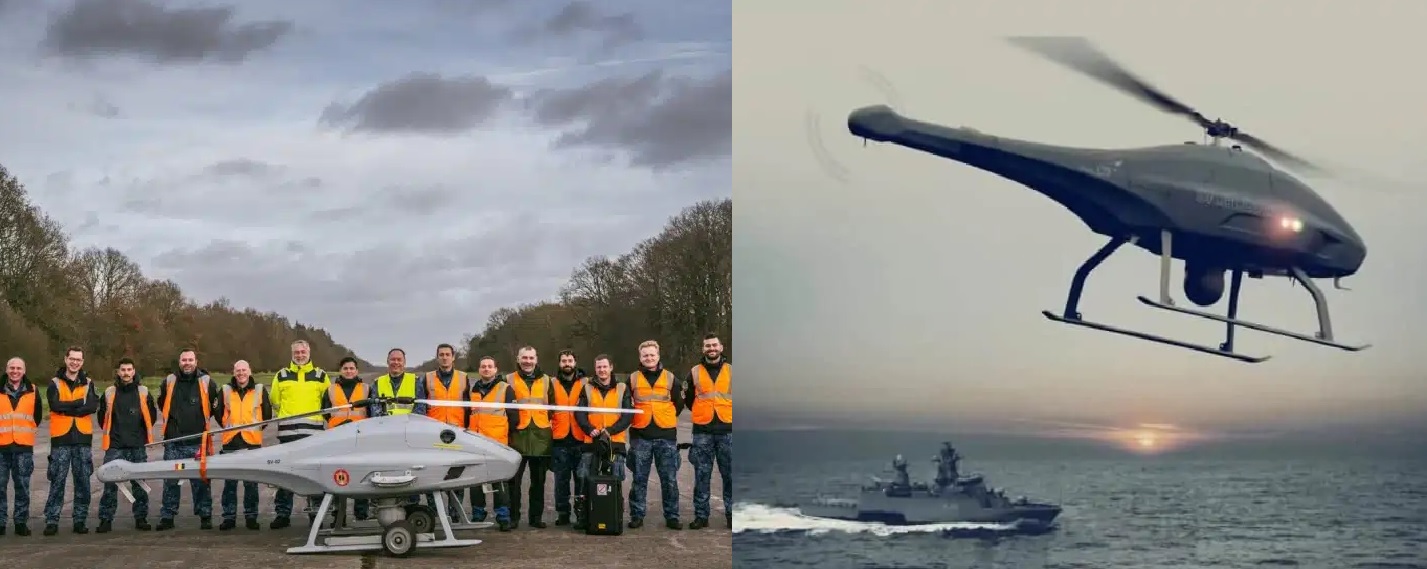
In a significant advance for European naval mine warfare, the Belgian Navy has successfully completed its first training flights of the Skeldar V-200 unmanned helicopter, laying the groundwork for a new era of remote, data-driven mine countermeasures. The initial trials were conducted in recent weeks at Ursel Airfield, a key training site for the service’s expanding unmanned aviation capability.
The Skeldar V-200 will become an integral sensor and surveillance asset for Belgium’s new-generation mine countermeasures vessels, enabling crews to detect, classify, and track naval mines at standoff distances—dramatically reducing the risk to sailors and ships operating in contested waters.
Unmanned Helicopter Designed for the Mine Threat
The Skeldar V-200 is a rotary-wing unmanned aerial system (UAS) optimized for maritime operations. With a rotor span of around 4.5 metres, a maximum weight of approximately 250 kilograms, and an endurance of up to four hours depending on payload, the platform is designed to remain airborne long enough to support sustained mine-hunting missions.
Operating via a secure data link, the unmanned helicopter can relay real-time information to operators aboard ship or ashore. According to Captain Kristof Van Belleghem, Chief of Staff of the Navy, this capability fundamentally changes how mine countermeasures are conducted. By extending the detection range well beyond the immediate vicinity of the ship, vessels can remain outside the minefield, enhancing survivability and operational safety.
Beyond seabed mines, the system is also suited to detecting drifting or floating mines, a persistent threat to shipping lanes and port approaches.
Focus on Piloting and System Mastery
The training campaign at Ursel has concentrated on pilot proficiency and system familiarisation. Operators are building routines, mastering flight controls, and accumulating the mandatory flight hours required for operational certification—an approach comparable to civilian and military aviation standards.
The Skeldar V-200 offers three distinct piloting modes. Operators can fly the aircraft manually with direct control over trajectory, speed, and altitude; employ an automatic mode following a predefined route; or conduct missions using fully programmed flight patterns, ideal for systematic area coverage during mine reconnaissance.
From Land to Sea: Flexible Deployment
Control of the Skeldar V-200 is carried out from a Remote Pilot System (RPS), effectively a dedicated cockpit that allows operators to monitor sensors, manage flight profiles, and respond to changing tactical conditions. While the first training flights relied on supplier-provided systems, Belgian Defence is set to field its own RPS units in the near future.
Crucially, these systems are also available in containerised configurations, allowing the unmanned helicopter to be deployed from both land bases and naval vessels. Although the aircraft is primarily intended for maritime use, training traditionally begins ashore, where simpler flight profiles can be executed in a controlled environment.
Building a Full Skeldar Fleet
Belgium currently operates two Skeldar V-200 drones, but this number is set to increase significantly. Over the coming years, the fleet will expand to ten unmanned helicopters, forming part of a modular mine countermeasures toolkit. Depending on mission requirements, different combinations of aerial, surface, and underwater drones can be embarked and deployed from sea or land.
This unmanned ecosystem is being introduced alongside Belgium’s new mine countermeasures vessels. The first of these ships, M940 Oostende, has already arrived in Zeebrugge, marking the tangible start of a long-term fleet renewal effort.
Belgium–Netherlands Partnership Drives Capability
The integration of the Skeldar V-200 also highlights the depth of Belgian–Dutch naval cooperation under the Replacement Mine Countermeasures (rMCM) programme. Conducted jointly with the Royal Netherlands Navy, the programme aims to completely modernise mine warfare capabilities for both countries.
In total, twelve advanced mine countermeasures vessels will be built—six for Belgium and six for the Netherlands—with the entire fleet scheduled to be fully operational by 2030. The programme was awarded in 2019 to Belgium Naval & Robotics, a consortium bringing together Naval Group and Exail.
The Skeldar training flights at Ursel were carried out in close coordination with Dutch counterparts, reinforcing interoperability and shared operational concepts from the earliest stages.
Positioning Europe at the Forefront of Mine Warfare
As naval mines continue to pose a low-cost but highly effective threat in modern conflicts, Belgium and the Netherlands are positioning themselves at the forefront of European mine countermeasures innovation. The successful initial operation of the Skeldar V-200 unmanned helicopter represents a critical step toward safer, more remote, and more efficient mine warfare, with lessons that are likely to resonate well beyond the North Sea.
✍️ This article is written by the team of The Defense News.