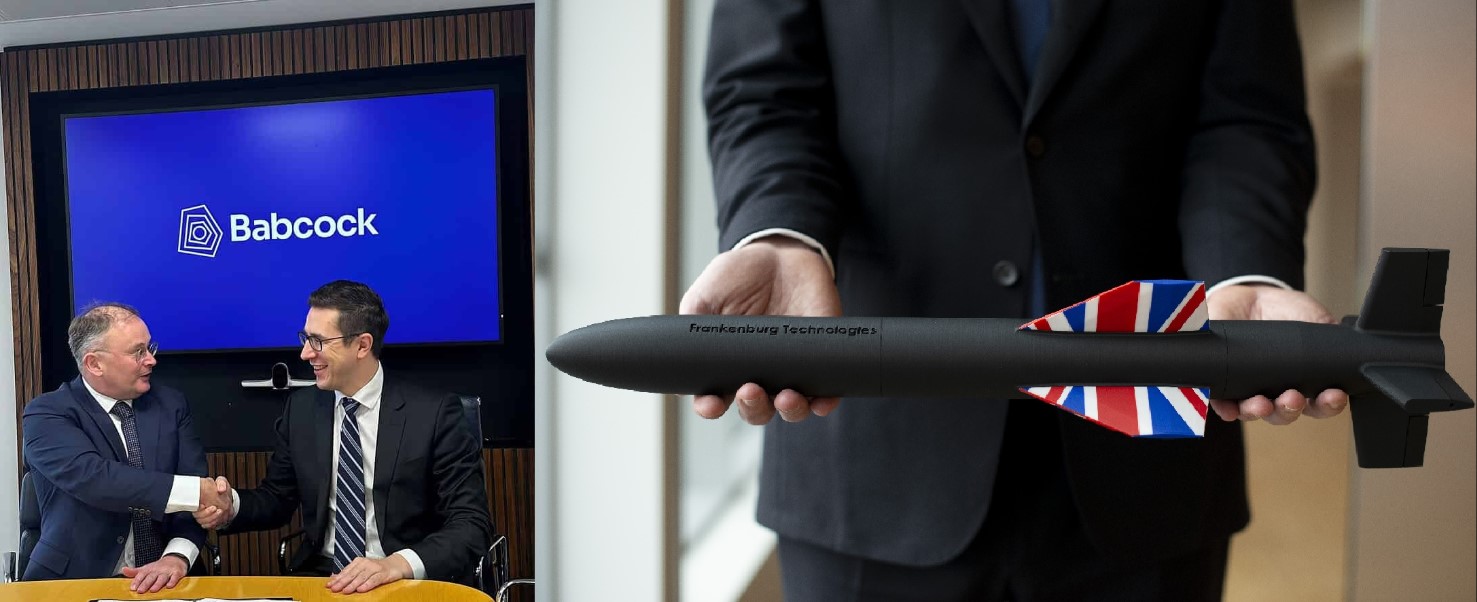
London / Tallinn — British defence engineering group Babcock has entered into a Memorandum of Understanding (MoU) with Estonian defence technology firm Frankenburg Technologies to jointly develop a new, affordable maritime counter-unmanned aerial system (C-UAS), addressing the rapidly escalating threat posed by one-way attack drones and loitering munitions across Europe.
The collaboration, announced through a Babcock press release, reflects growing urgency among NATO and European militaries to field scalable and economically sustainable air-defence solutions, as low-cost drones increasingly challenge traditional, high-value missile interceptors.
Containerised Maritime Launch System
Under the MoU, Babcock will design and manufacture a cost-effective, containerised launch platform optimised for maritime and coastal defence roles. Drawing on its long-standing expertise in naval launch systems and complex weapons integration, Babcock’s solution is intended to be rapidly deployable on warships, auxiliary vessels, ports, offshore installations and critical coastal infrastructure.
The containerised approach allows the system to be modular and scalable, enabling operators to tailor missile load-outs based on threat intensity while keeping costs under control. The system is designed to deliver kinetic, hard-kill protection as part of a layered counter-drone architecture, complementing electronic warfare and soft-kill measures.
Frankenburg’s Mark 1 Missile: Designed for Mass and Affordability
Central to the new system is Frankenburg Technologies’ Mark 1 counter-drone missile, a compact interceptor purpose-built to defeat small UAVs, one-way attack drones and loitering munitions at very short range.
The Mark 1 is a lightweight, ultra-short-range missile, measuring approximately 650 mm in length and weighing under 2 kg, making it significantly smaller than conventional air-defence interceptors. It uses a solid-fuel rocket motor to achieve rapid acceleration against low-altitude, slow-to-medium speed aerial targets.
Guidance is handled by an autonomous onboard system, allowing the missile to prosecute targets after launch without continuous external control. The seeker and guidance logic are designed to cope with cluttered environments and dense drone attacks, reducing dependence on vulnerable data links. The missile carries a compact high-explosive fragmentation warhead, optimised to destroy or disable small aerial targets efficiently.
With an effective engagement range of up to approximately 2 km, the Mark 1 is not intended to replace high-end surface-to-air missiles, but rather to fill a critical gap in close-range air defence, where using expensive interceptors against cheap drones has proven economically unsustainable.
A defining feature of the Mark 1 programme is its manufacturing philosophy. Frankenberg has designed the missile from the outset for high-volume production, enabling rapid output measured in hundreds of missiles per week. This approach supports the core objective of delivering order-of-magnitude cost reductions compared with legacy short-range air-defence missiles, allowing defenders to counter mass drone attacks with mass of their own.
Responding to the Changing Character of Warfare
Recent conflicts have underscored how swarms of inexpensive drones can overwhelm traditional air-defence systems. The Babcock–Frankenburg solution is intended to meet this challenge head-on by pairing low-cost interceptors with a robust, naval-grade launch system, suitable for continuous operations in harsh maritime environments.
The joint capability is expected to enhance protection for naval task groups, expeditionary forces and critical national infrastructure, particularly ports, shipyards and energy facilities that are increasingly exposed to asymmetric aerial threats.
Building Sovereign Capability and Export Potential
Although Frankenberg Technologies is headquartered in Estonia, its engineering leadership is based in the United Kingdom, aligning closely with Babcock’s domestic industrial footprint. The partnership is expected to contribute to the development of a new sovereign defence capability, supporting high-skilled jobs in the UK while strengthening Europe’s indigenous counter-drone industrial base.
Both companies see significant export potential, as allied nations seek affordable maritime and land-based C-UAS solutions that can be fielded quickly and in large numbers.
Industry Leaders on the Partnership
David Lockwood, Chief Executive Officer of Babcock, highlighted the urgency of industrial adaptation to new threats.
“Defence has entered a new era with the rapid development of drone warfare, and industry needs to respond to this growing threat. We work with the brightest start-ups on defence’s most critical challenges, and we’re pleased to be working with Frankenburg Technologies on the development of an innovative maritime counter-drone air defence system.”
Kusti Salm, Chief Executive Officer of Frankenburg Technologies, stressed the importance of designing air defence for scale from the outset.
“The drone threat has changed the character of warfare, and every layer of defence now needs to be designed for mass and speed. Partnering with Babcock allows us to combine rapid innovation with proven maritime and industrial expertise, accelerating the delivery of an operational counter-drone capability.”
Outlook
While the MoU stops short of a production contract, it establishes a framework for system development, integration and future trials. If successful, the Babcock–Frankenburg initiative could deliver a deployable, export-ready maritime C-UAS solution, tailored to the realities of drone-dominated conflict and the growing need for affordable, high-volume air defence in the years ahead.