Australia Plan to Hand Over Decommissioned Tiger Attack Helicopters to Ukraine
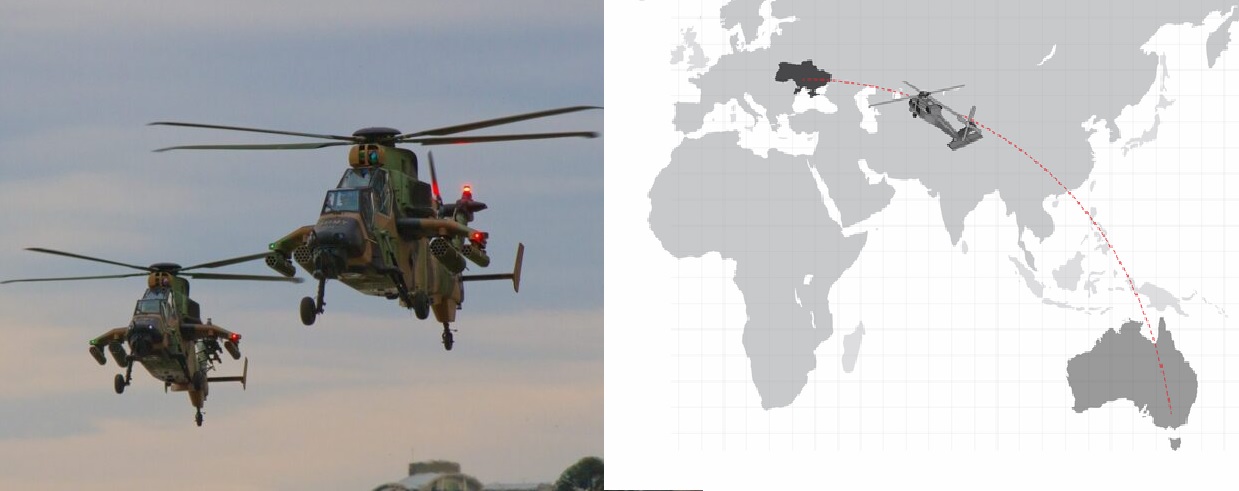
Australia is preparing to send its ageing fleet of Tiger attack helicopters to Ukraine as part of a possible new military aid package, with Canberra now actively examining how many aircraft could be transferred and when they might leave Australian service, according to reports citing government sources.
The discussions, first reported by ABC News, come as the Albanese government weighs fresh support for Kyiv and faces renewed pressure to make use of equipment already earmarked for retirement rather than scrapping it.
From Troubled Fleet to Battlefield Asset for Ukraine
Australia operates 22 Eurocopter Tiger ARH (Armed Reconnaissance Helicopter) aircraft, acquired under Project AIR 87 after a 2001 contract with Eurocopter (now Airbus Helicopters). All 22 were delivered by 2011 and form the core of the Army’s armed reconnaissance regiment.
Canberra decided in 2016 to retire the Tigers early and replace them with the US-built AH-64E Apache Guardian, citing high sustainment costs, persistent reliability issues and the small global fleet that makes logistics difficult. The current plan is for Tiger operations to end no later than 2027–28, as 29 Apaches are delivered through to 2029.
Although the Tigers are still in service, the Australian Defence Force has begun drawing down the fleet and scaling back investment in upgrades. That has created an opportunity: aircraft with significant remaining flight hours but limited future use in Australia could be transferred to Ukraine, where any additional attack helicopter capability is in high demand.
Australian media and specialist defence outlets say officials are now working through how many of the 22 Tigers could be made available, what refurbishment would be needed, and how quickly Ukrainian crews could be trained. No final number has been announced, and the government has so far described the move as under consideration rather than a done deal.
Why the Tigers are Being Replaced
The Tiger ARH marked a major leap in capability for the Australian Army when it entered service in the mid-2000s. But the program ran into repeated delays and technical problems. Final Operational Capability was only declared in 2016, about seven years later than originally planned, and even then the system still had dozens of outstanding deficiencies.
An Australian National Audit Office review and multiple Defence white papers highlighted recurring issues:
-
High sustainment and maintenance costs compared with expectations.
-
Lower than planned availability, partly due to the need to send key components back to Europe for repair.
-
The challenge of supporting a niche European helicopter type with a relatively small global user base.
These problems, combined with the desire for greater interoperability with US forces, led Canberra to select the AH-64E Apache as the Tiger’s replacement under project LAND 4503. The first Apaches arrived in 2025, with more deliveries scheduled over the next few years.
For Ukraine, however, the calculation is different. Even if the Tigers are more expensive and complex to sustain than Western rivals, they would still represent a significant boost in dedicated attack helicopter capability and could be used alongside donated Western ground-based air-defence and artillery systems.
What The Tiger ARH Can Do
The Tiger ARH is a twin-engine, two-seat attack and reconnaissance helicopter designed for armed escort, close air support and anti-armour missions. Key characteristics include:
-
Crew: 2 (pilot and weapons systems officer in tandem cockpit).
-
Engines: 2 × MTR390 turboshafts, each around 870–950 kW (1,160–1,300 shp).
-
Dimensions: overall length about 15 m, rotor diameter 13 m, height around 3.8–5.2 m depending on configuration.
-
Weight: maximum take-off weight roughly 6,000–6,600 kg.
-
Performance:
-
Top speed around 290–315 km/h
-
Combat range up to 800 km, extendable to around 1,300 km with external tanks
-
Endurance about 3 hours in typical missions.
-
The Australian ARH configuration is heavily armed and customised:
-
30 mm Nexter chin-mounted automatic cannon with several hundred rounds for close support.
-
AGM-114 Hellfire II anti-tank missiles on wing pylons for armoured and hardened targets.
-
70 mm unguided rockets (Hydra or FZ) in 7- or 19-tube launchers for area suppression.
-
Mistral or Stinger short-range air-to-air missiles for self-defence against helicopters and low-flying aircraft.
A roof-mounted sight with thermal imaging, laser designator and rangefinder allows the crew to detect, identify and engage targets at long range day or night. The helicopter also carries modern communications and data links, and an electronic warfare/self-protection suite with missile warning and countermeasures.
What It Would Mean For Ukraine
If the transfer goes ahead, Ukraine would likely need:
-
Training pipelines for pilots, weapons officers and ground crews, potentially conducted in Australia or at a third-country training facility.
-
A support and spares package, since the Tiger’s complex systems and limited user base make logistics challenging.
-
Integration with existing Ukrainian command and control, including safely employing Hellfire or equivalent missiles and coordinating with ground forces.
For Kyiv, even a partial fleet – for example 12–16 airframes out of Australia’s 22 – could provide a specialised attack helicopter regiment capable of hunting armour, supporting ground offensives and conducting deep strike missions, particularly if paired with Western intelligence and targeting.
For Canberra, sending the Tigers would:
-
Demonstrate that Australia is willing to move beyond financial support and vehicles to high-end combat aviation platforms.
-
Avoid the politically sensitive option of simply mothballing or scrapping expensive helicopters that still have usable life left.
-
Strengthen ties with European partners who are also supplying advanced systems to Ukraine.
However, officials caution that no final decision or transfer schedule has been formally announced. The government is still assessing operational risk during the transition to Apache, legal and export control issues with European partners, and the cost of preparing the helicopters for handover.
A Symbolic And Practical Shift
If Australia ultimately hands over its Tiger ARH fleet, it would mark the end of a two-decade experiment with a sophisticated but sometimes troubled European attack helicopter – and the beginning of a new chapter for the aircraft over Ukraine’s battlefields.
For Kyiv, the Tigers would not replace the need for more air defence systems, drones and artillery ammunition. But as dedicated attack platforms with powerful sensors and precision weapons, they could give Ukrainian forces a sharper edge in contested battles along the front lines, turning retired Australian hardware into a fresh dose of combat power.
About the Author
Aditya Kumar:
Defense & Geopolitics Analyst
Aditya Kumar tracks military developments in South Asia, specializing in Indian missile technology and naval strategy.