America’s Secret F-47 “Ghost Eagle” Fighter Jet Fly With Five Armed Autonomous Drones

In one of the most significant aviation developments of the decade, the United States has begun lifting the veil on a fighter jet long whispered about in defense circles—the Boeing-built F-47 “Ghost Eagle,” once sealed behind the classified walls of Area 51. The aircraft is now entering production as the centerpiece of the Pentagon’s Next Generation Air Dominance (NGAD) program. Senior military officials confirm that the F-47 will conduct its maiden flight in 2028, marking the moment when the world’s first true sixth-generation combat aircraft steps into operational reality.
A Secret Aircraft Finally Acknowledged
Hints of the aircraft’s existence surfaced earlier through brief remarks by former President Donald Trump, who described it as “a big secret” and admitted, “We don’t show too much of the plane for that reason.” According to defense sources, early prototypes have been undergoing classified tests deep inside Area 51, with limited access even within the military. What is now known confirms that the F-47 is intended to leap ahead of every fighter currently flying—American or foreign.
Built for Total Air Superiority
The United States Air Force plans to procure 185 F-47s, replacing the F-22 Raptor as America’s premier air-dominance platform. At its core, the Ghost Eagle is built for extreme stealth, long-range engagements, and seamless integration with autonomous systems. Initial data from the Air Force outlines the jet’s performance ambitions:
-
Top speed: Around Mach 2
-
Range: More than 1,800 km
-
Combat role: Air superiority, deep-strike escort, electronic warfare
-
Operational doctrine: Human–AI team-based air combat
Officials describe the F-47 not merely as an aircraft, but as an “air combat ecosystem” designed to dominate contested skies where future wars are most likely to unfold.
Five Armed Drone Wingmen: A First in Military Aviation
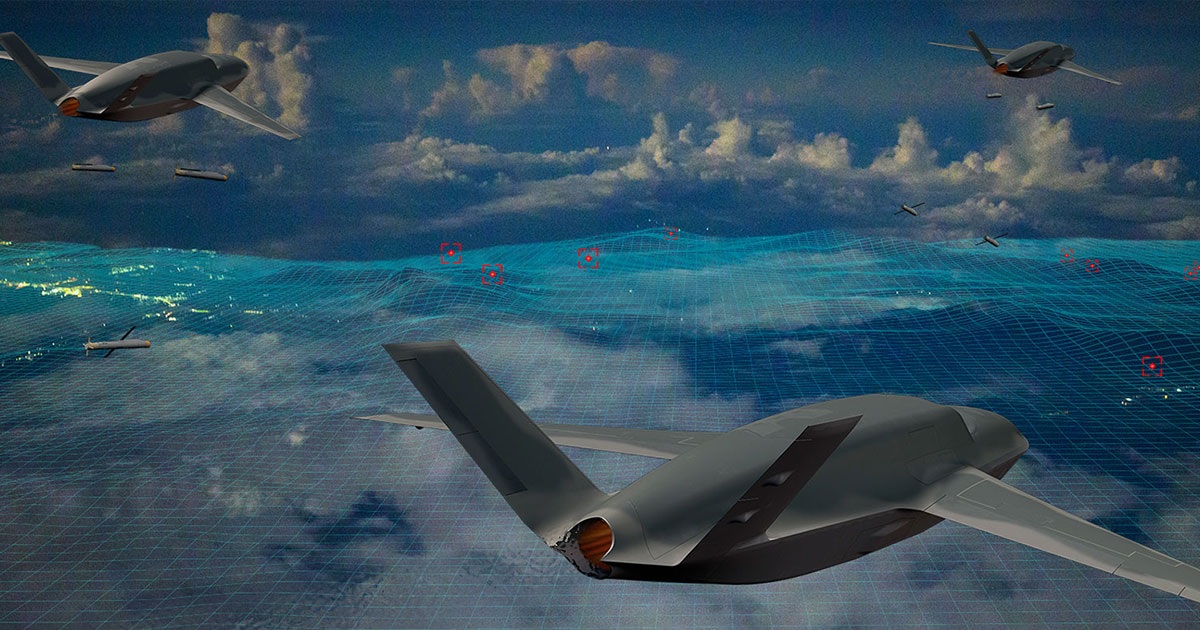
Perhaps the defining leap of the F-47 program is its integration with five autonomous drone wingmen, each capable of carrying weapons, sensors, and electronic-warfare payloads. These drones will form a protective and offensive web around the fighter, extending its situational awareness and striking power.
Defense analysts believe Boeing’s MQ-28 Ghost Bat—originally developed with the Royal Australian Air Force—is the leading candidate for this role. Evidence of this integration is already emerging. In November 2025, Boeing confirmed that the Ghost Bat will begin AIM-120 AMRAAM missile testing in December 2025, an important step toward fielding an armed, AI-enabled escort drone for next-generation U.S. fighters.
Inside the F-47: A Look at Its Next-Generation Systems
While most capabilities remain classified, multiple defense briefings and industry disclosures suggest the Ghost Eagle incorporates several unprecedented technologies:
-
AI-assisted targeting and automated threat prioritization
-
A dynamic stealth coating that adapts to radar and infrared scans
-
Quantum-encrypted communications for jamming-resistant data links
-
Hypersonic weapon compatibility, including future air-to-air missiles
-
Directed-energy weapon support, hinting at onboard laser systems
-
Multi-domain sensor fusion, linking satellites, ships, and ground units
-
Adaptive-cycle engines that shift between high-speed thrust and efficient cruise
This architecture is designed to make the F-47 not just harder to detect, but able to defeat threats before those threats even know it’s there.
Beyond the F-22 and F-35
The Ghost Eagle represents the first major shift in U.S. air-combat philosophy since the introduction of the F-22. Whereas legacy fighters rely heavily on pilot awareness, the F-47 integrates advanced AI to carry out tasks autonomously, from sensor management to defensive maneuvers.
Defense officials argue that the aircraft puts the U.S. a decade ahead of rivals, with China and Russia both racing to field their own sixth-generation fighters. If current estimates hold true, the F-47 will be the world’s first operational aircraft capable of coordinating AI-driven multi-axis attacks, using its drone escorts to overwhelm enemy defenses from several directions simultaneously.
Why the F-47 Matters Now
The timing of the Ghost Eagle’s emergence is no accident. Both Beijing and Moscow have accelerated development of advanced fighters, long-range air defenses, and autonomous combat drones. U.S. planners warn that failing to innovate could erode America’s long-standing technological edge.
The F-47 is seen as the answer to this challenge—a platform designed to operate in the world’s toughest air-defense environments, from the South China Sea to Eastern Europe. Pentagon officials say the aircraft is built to ensure the U.S. retains air superiority even in a world where drones, hypersonic weapons, and advanced radars dominate the battlespace.
What Comes Next
With production now underway, the F-47 program is now entering its most critical phase. The coming years will see expanded prototype testing at classified facilities, where engineers and pilots will push early airframes through high-stress evaluations. Parallel to this, the aircraft will begin integration and formation flights with MQ-28 drone wingmen as the Air Force tests the coordination, autonomy, and tactical behavior of the manned-unmanned team. The program will then move into a series of live-fire weapons trials, which will include long-range missile launches and, eventually, tests involving next-generation hypersonic systems designed for air-to-air and air-to-ground roles.
All of this will lead toward a formal public rollout of the F-47 ahead of its scheduled first flight in 2028. Defense insiders expect that additional information about the aircraft will emerge over the next two years, but emphasize that many of the F-47’s most advanced capabilities will remain classified well into the future.
A New Chapter in Air Warfare
The F-47 Ghost Eagle marks the beginning of a new era in aerial combat—one defined by AI-enhanced decision-making, stealth that adapts in real time, autonomous drone partners, and weapons operating at extreme ranges. Once hidden inside America’s most secretive test facilities, the Ghost Eagle is now on track to become the most advanced fighter jet ever produced, signaling the dawn of a new air-power revolution.
About the Author
Aditya Kumar:
Defense & Geopolitics Analyst
Aditya Kumar tracks military developments in South Asia, specializing in Indian missile technology and naval strategy.