American Rheinmetall and GM Defense Present HX3 Tactical Truck Set to Replace 40,000 U.S. Army Vehicles
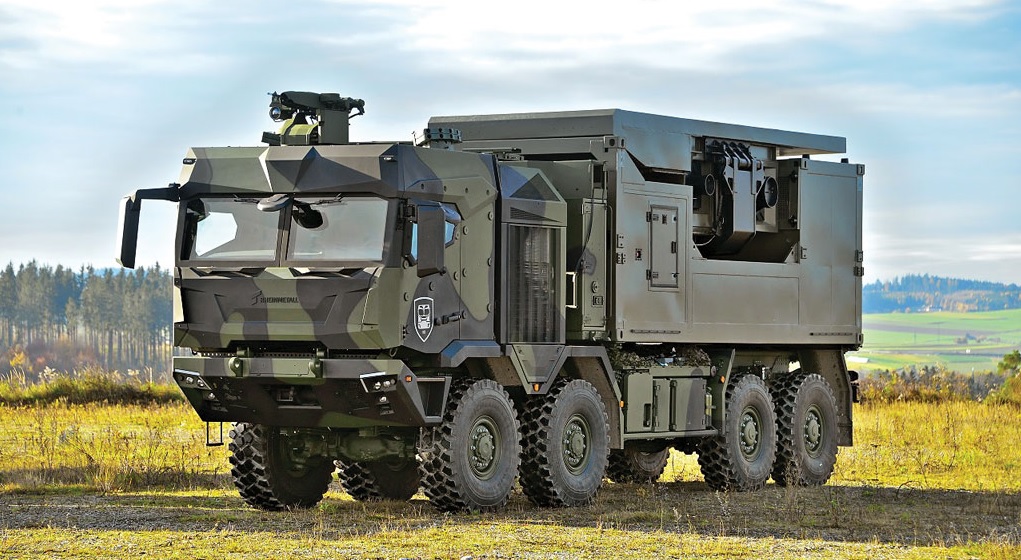
At the AUSA 2025 Exhibition in Washington, D.C., American Rheinmetall Defense and GM Defense unveiled the HX3 Common Tactical Truck (HX3 CTT), a state-of-the-art logistics platform designed to modernize the U.S. Army’s ground mobility fleet. The truck, developed under the $14 billion Common Tactical Truck (CTT) program, is intended to replace nearly 40,000 heavy tactical trucks, including the M915, HEMTT, and PLS series, over the next decade.
The HX3 CTT represents a leap forward in tactical logistics, blending Rheinmetall’s proven HX3 series design with GM Defense’s American automotive and electrification expertise. Tailored specifically for U.S. Army operations, it features advanced drive-by-wire control, leader-follower autonomous capability, and cybersecurity-hardened systems that enable secure digital integration on the modern battlefield.
The version displayed at AUSA 2025 also included Invariant’s Counter-UAS module, highlighting the vehicle’s role not only as a logistics carrier but also as a defensive support platform. This modular approach allows rapid reconfiguration for missions ranging from resupply and recovery to electronic warfare and command support.
Built on a robust HX3 chassis, the truck offers improved mobility, higher payload capacity, and enhanced crew protection. It is equipped with an armored cab, central tire inflation system (CTIS) for terrain adaptability, and hybrid-electric drive readiness for future silent mobility and fuel efficiency. The vehicle’s modular structure also supports integration of autonomous systems and electric propulsion as technology matures.
Rheinmetall’s long-standing experience in producing tactical trucks for NATO forces, combined with GM Defense’s innovation in commercial electric vehicle technology, has resulted in a vehicle that merges battlefield durability with smart logistics automation. The HX3 CTT’s open systems architecture allows it to integrate emerging technologies quickly, from AI-based vehicle control to next-generation data links.
According to Rheinmetall officials, the HX3 CTT was designed with a clear focus on reducing lifecycle costs and simplifying fleet maintenance, ensuring that different mission configurations can be sustained using common parts and service networks. Automated diagnostics and predictive maintenance systems are expected to significantly enhance fleet uptime and readiness.
The Common Tactical Truck program is one of the most significant modernization initiatives for the U.S. Army’s logistics branch, aiming to create a digitally connected and autonomous logistics ecosystem. By standardizing vehicle architecture, the Army seeks to reduce its logistics footprint while improving operational efficiency and survivability in contested environments.
As the HX3 CTT enters the evaluation phase, its performance in upcoming field trials and operational demonstrations will determine its path toward potential production. If selected, the vehicle will redefine how the U.S. Army moves supplies, equipment, and personnel across future battlefields — bridging the gap between today’s tactical logistics and tomorrow’s autonomous military mobility.
The unveiling of the HX3 CTT at AUSA 2025 signifies not only a step toward a more resilient logistics network but also a strategic shift toward autonomy, modularity, and sustainability in U.S. military operations. With its combination of German engineering and American innovation, the HX3 Common Tactical Truck stands as a symbol of the future of military transport — smarter, stronger, and ready for the battlefield of tomorrow.
About the Author
Aditya Kumar:
Defense & Geopolitics Analyst
Aditya Kumar tracks military developments in South Asia, specializing in Indian missile technology and naval strategy.