After Op Sindoor Success, Indian Army to Order More GPS-Guided Excalibur Artillery Shells

Following the resounding success of Operation Sindoor in May 2025, the Indian Army is now preparing to place additional orders for the M982 Excalibur GPS-guided artillery shells. The move comes after the Army used these precision rounds to destroy seven high-value terrorist targets across the Line of Control (LoC), delivering a powerful message while ensuring zero collateral damage.
This development marks a major step in India’s shift toward precision warfare, with artillery now playing a surgical role in operations traditionally dominated by air power.
The Operation That Proved a Point
During Operation Sindoor, the Indian Army’s artillery regiments — equipped with M777 ultralight howitzers and surveillance drones — struck a series of terror camps and launch pads located in Pakistan-occupied Kashmir (PoK). Out of nine identified targets, seven were destroyed using precision-guided munitions, primarily the M982 Excalibur.
These strikes were conducted at standoff ranges of 6 to 16 kilometers, with laser or GPS data fed from overhead drone surveillance. Despite the complex terrain and densely clustered enemy hideouts, the shells hit with sub-5-meter accuracy.
A senior officer told The New Indian Express:
“This operation was not just about firepower — it was about demonstrating that our artillery can now strike with the same precision as air-delivered bombs.”
What Is the Excalibur Shell?
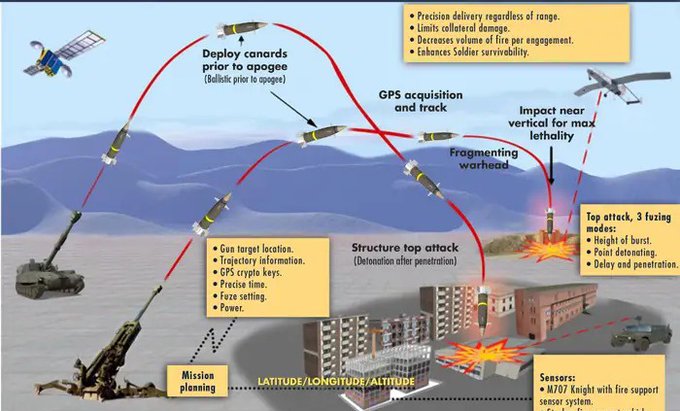
The M982 Excalibur is a 155mm extended-range, precision artillery round developed by Raytheon and BAE Systems. It uses a GPS+Inertial Navigation System (INS) for mid-course correction and features:
-
Range: Up to 50 km
-
Accuracy: Circular Error Probable (CEP) of <4 meters
-
Fuze Options: Airburst, delay, and impact — allowing top attack on structures or penetration before detonation
-
Warhead: Fragmentation-based, optimized for maximum lethality against soft targets and fortified bunkers
This system allows artillery to be used like a sniper rifle — precise, deliberate, and surgical.
India’s Growing Excalibur Inventory
India first procured Excalibur shells from the United States in 2019, as an urgent purchase to complement the newly inducted M777 howitzers. The first batch included around 500 shells with standard precision and 100 with enhanced CEP (2 meters).
Since then, the Army has continued to test and integrate Excalibur rounds with other 155mm platforms like the K9 Vajra-T and Dhanush guns, supported by battlefield surveillance radars and UAVs.
After Operation Sindoor, sources confirm that the Army has requested new procurement, which will likely:
-
Expand operational reserves
-
Ensure readiness for precision retaliation across LoC and LAC
-
Enhance integration with drone and satellite-guided targeting platforms
Precision in the Mountains: Why It Matters
Mountain warfare — particularly along the LoC — demands low-collateral, high-accuracy strikes. Terrorist camps are often located near civilian infrastructure or in rugged terrain, making conventional shelling ineffective or risky.
The Excalibur changes that equation. Its near-vertical terminal dive angle, real-time guidance, and programmable fuzing allow it to:
-
Hit specific buildings or cave mouths
-
Penetrate rooftops or bunkers before exploding
-
Minimize unintended damage even in populated valleys
Paired with the Indian Army’s UAV fleet and fire-control networks, Excalibur has transformed artillery into a smart strike force — all from a position of safety, without crossing the border.
The Ministry of Defence is now evaluating larger batch purchases of Excalibur shells. Meanwhile, DRDO is also working on indigenous GPS- and NavIC-guided artillery shells, though Excalibur remains India’s most combat-tested option for now.
Reports also indicate that Indian artillery regiments are training for automated fire missions, where target data from drones is fed directly to fire control systems — cutting response time from minutes to seconds.
With seven terror hideouts flattened during Operation Sindoor using Excalibur rounds, the Indian Army has proven that precision-guided artillery is not just a luxury — it's a battlefield necessity.
Now, with additional orders in the pipeline, India is fortifying its firepower with smart shells that can strike surgically, deeply, and decisively — marking the future of modern ground warfare.
✍️ This article is written by the team of The Defense News.