Afghan Forces Claim Pakistani Air Force Drone Shot Down
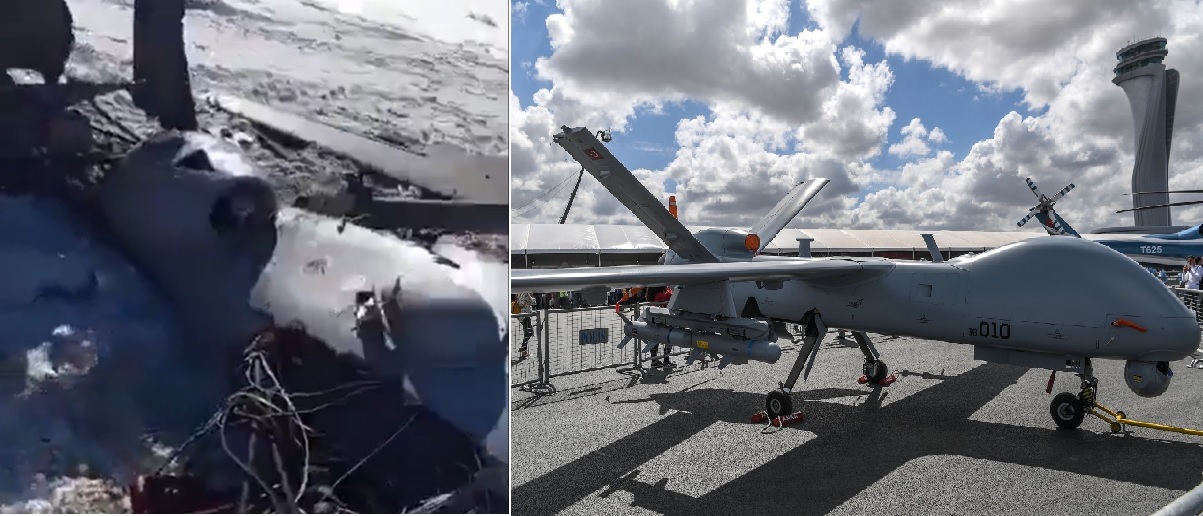
Reports and social-media posts circulating on X (formerly Twitter) and other platforms claim Afghan forces shot down a drone allegedly operated by the Pakistan Air Force (PAF) inside Afghanistan, with “more details awaited” as officials have yet to release a full statement or technical readout. One widely shared post described a drone crash near Maidan Shahr, the provincial capital of Maidan Wardak, while other posts framed the incident as an air-defense interception rather than a mechanical failure.
As of publication, no independently verifiable official confirmation from Kabul or Islamabad has appeared in major wire reporting on this specific shootdown claim, and the available footage and images have not been authenticated by an independent third party. The episode is unfolding against a backdrop of elevated cross-border tensions, including recent exchanges of fire and competing allegations of drone and air strikes.
Video Analysis Points To A MALE-Class Drone, But Identification Is Contested
Open-source observers reviewing the visuals have floated multiple possibilities for the aircraft type. Some posts suggested the wreckage resembles an Israeli Heron-type UAV, while other discussions compared it to U.S.-origin silhouettes such as the MQ-9 Reaper. Additional commentary argued it could be a Chinese Wing Loong / CH-4-family lookalike.
Separately, a growing thread of analysis has suggested the drone “may be” from Turkey’s TAI ANKA family—an identification that, if confirmed, would be notable because the ANKA is widely regarded as a Medium-Altitude Long-Endurance (MALE) platform used for long-dwell surveillance and, in some variants, strike missions. At this stage, however, the ANKA link remains inference, not a confirmed designation, as publicly available imagery does not clearly show serial numbers, operator markings, or a unique payload fit that would make identification definitive.
Why The ANKA Theory Is Plausible In The Pakistan Context
The TAI ANKA is a Turkish-developed MALE UAV produced by Turkish Aerospace Industries. Open-source reference material lists the Pakistan Air Force among operators and notes that components are manufactured under license at Pakistan Aeronautical Complex (PAC), Kamra, indicating an established industrial relationship around the platform.
The ANKA’s known mission set—persistent ISR (Intelligence, Surveillance, Reconnaissance) and, for some configurations, weapons carriage—aligns with the type of asset a military would deploy in a high-tension border environment where both sides accuse each other of cross-border activity.
What The ANKA-S Is, And The Numbers Associated With It
If the drone involved is an ANKA variant, the most commonly referenced operational model is the ANKA-S, associated in some configurations with beyond-line-of-sight operations via satellite communications.
Open-source specifications frequently cite ANKA-family endurance in the 24–30 hour class. A widely referenced profile lists the ANKA-S payload capacity at ~200 kg, supporting EO/IR sensors and other mission systems.
Additional reporting on the platform’s size and performance cites a ~17.5-meter wingspan, ~8-meter length, maximum take-off weight around ~1,700 kg, endurance of 24–30 hours depending on load, cruise speed around ~204 km/h, and an operational ceiling near 30,000 ft, with some sources describing up to ~12,000 meters (≈39,000 ft) for newer developments or related variants.
Because multiple ANKA variants exist, and sources do not always agree on which figures apply to which sub-model, any identification of the wreckage as “ANKA” would still require confirmation of the exact variant to lock in a precise performance baseline.
The Wider Backdrop: A Drone-Heavy Afghanistan–Pakistan Confrontation
The alleged shootdown claim emerges during a period of heightened Afghanistan–Pakistan tensions, marked by border closures, firefights, and competing claims of air and drone strikes. International reporting has previously documented closures of key crossings following exchanges of fire and allegations tied to strikes and retaliation along the frontier.
Accusations by Afghanistan’s Taliban government that Pakistan carried out drone strikes—which Pakistan has denied—underscore how rapidly claims and counterclaims now move, often outpacing verifiable detail.
What To Watch Next
The facts that would settle the story—where the drone came down, whether it was shot down or crashed, who operated it, and what model it was—typically hinge on a small set of follow-on disclosures: official Afghan statements, recovered-component photographs showing data plates, and confirmation or denial from Pakistan.
Until such evidence emerges, the most responsible framing is that a drone incident has been reported and visually documented in open channels, while the claim it involved a PAF aircraft—potentially a Turkish-made ANKA—remains unconfirmed pending official detail and independent verification.
About the Author
Aditya Kumar:
Defense & Geopolitics Analyst
Aditya Kumar tracks military developments in South Asia, specializing in Indian missile technology and naval strategy.