Hyundai Rotem Begins Trials of Hydrogen Hybrid 8×8 Armoured Vehicle: A Step Toward Next-Gen Military Mobility

In a bold move toward sustainable and future-ready defence technologies, Hyundai Rotem is preparing to launch mobility trials of its new 8×8 armoured vehicle powered by a hybrid hydrogen-electric propulsion system. The trials, set to begin before the end of 2025, mark a significant milestone in the company’s effort to develop zero-emission, high-endurance military platforms capable of operating in demanding combat environments.
A Dual-Use Technology Advantage
The development of hydrogen-based propulsion for armoured vehicles demonstrates a growing convergence between civilian and military innovation. Major industrial groups like Hyundai enjoy a natural advantage in this space — their R&D in civil automotive systems often finds direct application in military platforms.
Hyundai Rotem’s Hydrogen Fuel Cell Tram, already considered one of the most advanced urban mobility solutions globally, provided much of the technological foundation for this effort. At ADEX 2025, the company showcased two key developments:
-
Black Veil, an unmanned 4×4 electric mobility platform using hydrogen fuel cells with a range of 350 km.
-
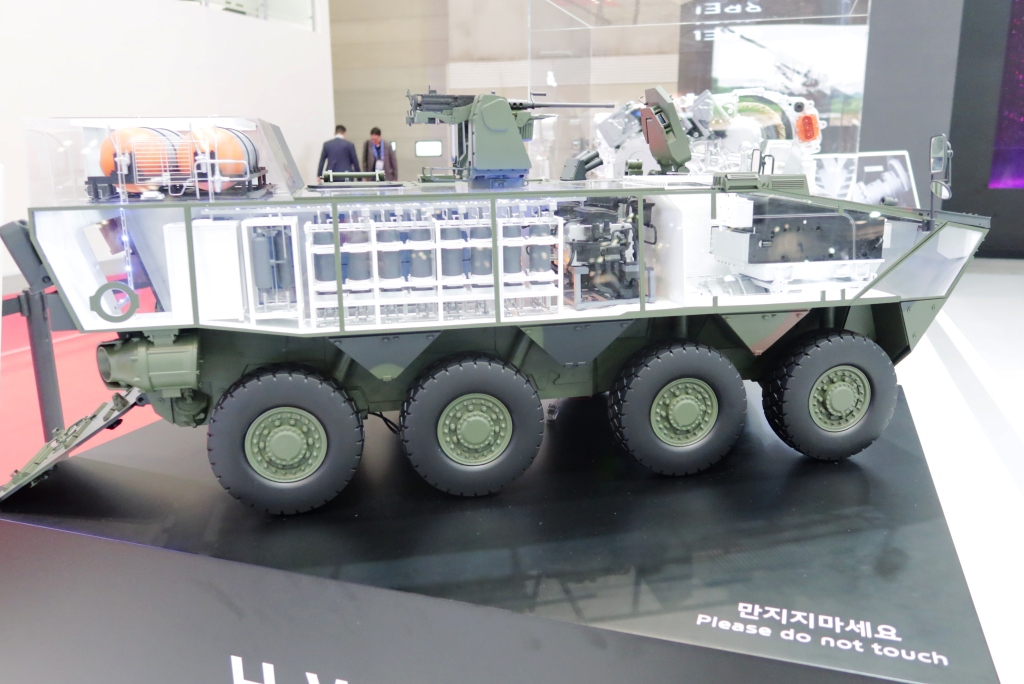
A scale model of the H2WAVe (Hydrogen Wheeled Armoured Vehicle electric), an 8×8 hybrid concept designed for future military deployment.
Inside the H2WAVe: Engineering and Power
The H2WAVe’s hybrid propulsion system combines a 350 kW (470 hp) electric motor operating above 600 volts, drawing energy from high-capacity batteries continuously recharged by two hydrogen fuel cells.
The design prioritises modularity and efficiency. Instead of traditional powertrains, the vehicle uses electric drive units (EDUs) for propulsion, eliminating many complex mechanical components like transmissions and transfer cases.
-
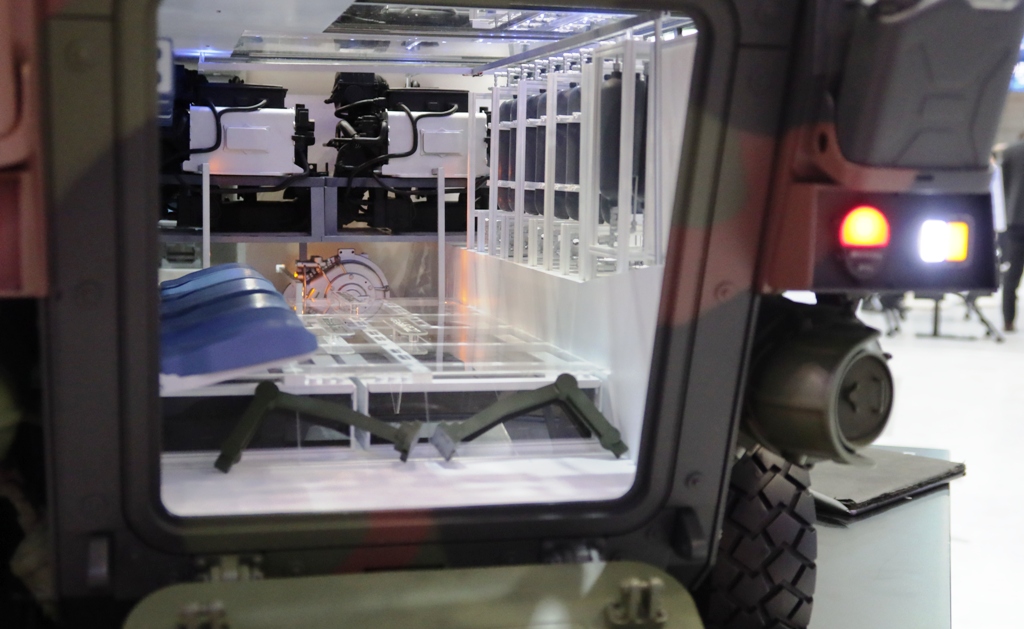
Hydrogen Storage: Two 700-bar pressure tanks mounted in a protected pod over the rear roof section.
-
Energy System Layout: Batteries and fuel cells positioned centrally for balance, while five sodium cylinders occupy the right side of the crew compartment.
-
Crew Arrangement: Five personnel seats along the left wall, reflecting a modified internal architecture due to the new propulsion system.
Performance and Safety
With its hybrid configuration, the H2WAVe achieves a power-to-mass ratio of 19–23 hp/ton, comparable to the conventionally powered K808 armoured vehicle, which uses a 420 hp diesel engine. Though the prototype employs a single-motor configuration for simplicity, Hyundai Rotem is already planning a multi-axle electric drive setup — allowing one motor per axle.
Such a system would not only improve torque distribution and off-road capability but also enhance survivability, as damage to one motor or axle would not immobilise the entire vehicle.
Safety remains a top concern, particularly given the use of hydrogen on a battlefield. Hyundai Rotem engineers acknowledge the associated risks but view this phase as a technology demonstrator rather than an operational prototype. Future iterations will focus on miniaturisation, shielding, and battlefield survivability.
Electric Drive Unit (EDU): The Future Core
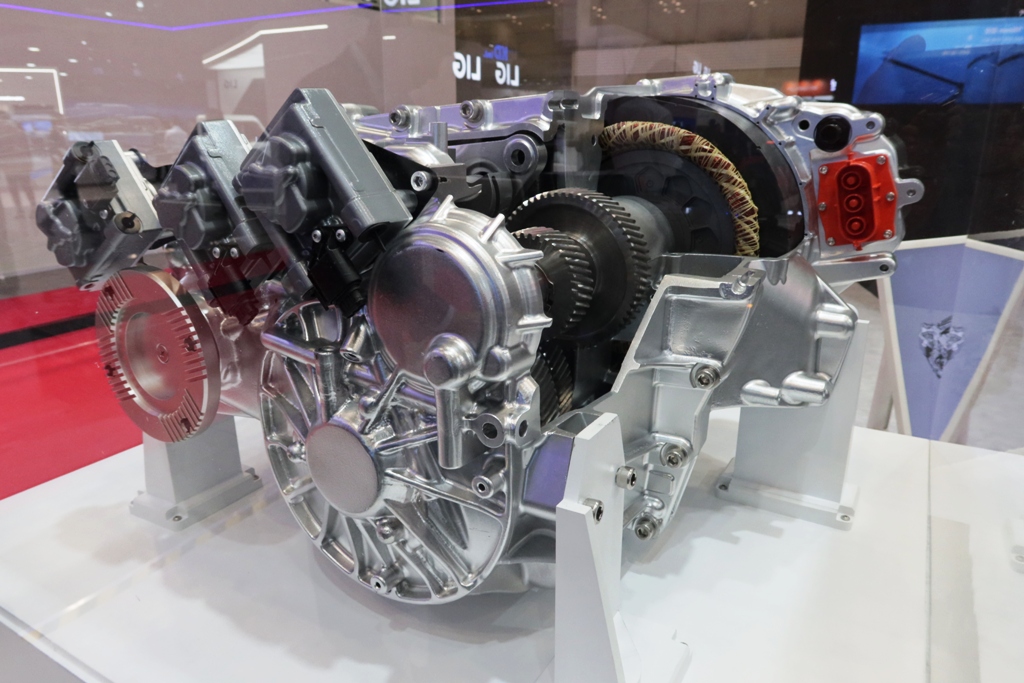
Displayed alongside the H2WAVe model was the company’s Electric Drive Unit, a compact power module featuring differential lock and parking lock systems. Each EDU can be activated or disconnected independently, meaning the vehicle can run in 8×8 or 8×4 modes depending on terrain and mission needs — conserving energy during transit and maximising output in combat.
Although Hyundai Rotem has not revealed detailed power figures, analysts suggest each EDU should generate over 90 kW, maintaining total system output near the 350 kW benchmark.
Hydrogen on the Battlefield: Promise and Challenge
The adoption of hydrogen fuel cell technology in armoured platforms represents a paradigm shift in military logistics. Unlike diesel, hydrogen offers:
-
Silent operation for stealth movement.
-
Reduced thermal signature, improving survivability.
-
Independence from fossil fuels, aligning with global decarbonisation efforts.
However, storage, refuelling infrastructure, and safety remain major hurdles. High-pressure hydrogen tanks must be protected from shrapnel and ballistics, and battlefield refuelling will require mobile hydrogen generation or supply systems — areas Hyundai Rotem and South Korea’s defence research community are already exploring.
Long-Term Vision: 2035–2040
Company sources told EDR On-Line that Hyundai Rotem’s long-term objective is to field operational hydrogen-based armoured vehicles by 2035–2040. The ongoing H2WAVe trials will run through late 2026, gathering vital performance, safety, and maintenance data.
This aligns with South Korea’s broader defence-industrial vision — integrating green energy technologies into its next generation of land systems, while reducing dependency on imported fossil fuels.
The Hyundai Rotem H2WAVe project represents more than a new vehicle — it is a strategic shift toward sustainable defence innovation. By leveraging hydrogen fuel cells and hybrid electric propulsion, Hyundai is positioning itself at the forefront of a global transformation that could redefine how armies move, fight, and sustain themselves in the 21st century.
If successful, the H2WAVe could pave the way for low-signature, high-endurance combat vehicles, offering a glimpse of the battlefield of 2040 — one powered not by diesel, but by hydrogen and silence.
About the Author
Aditya Kumar:
Defense & Geopolitics Analyst
Aditya Kumar tracks military developments in South Asia, specializing in Indian missile technology and naval strategy.