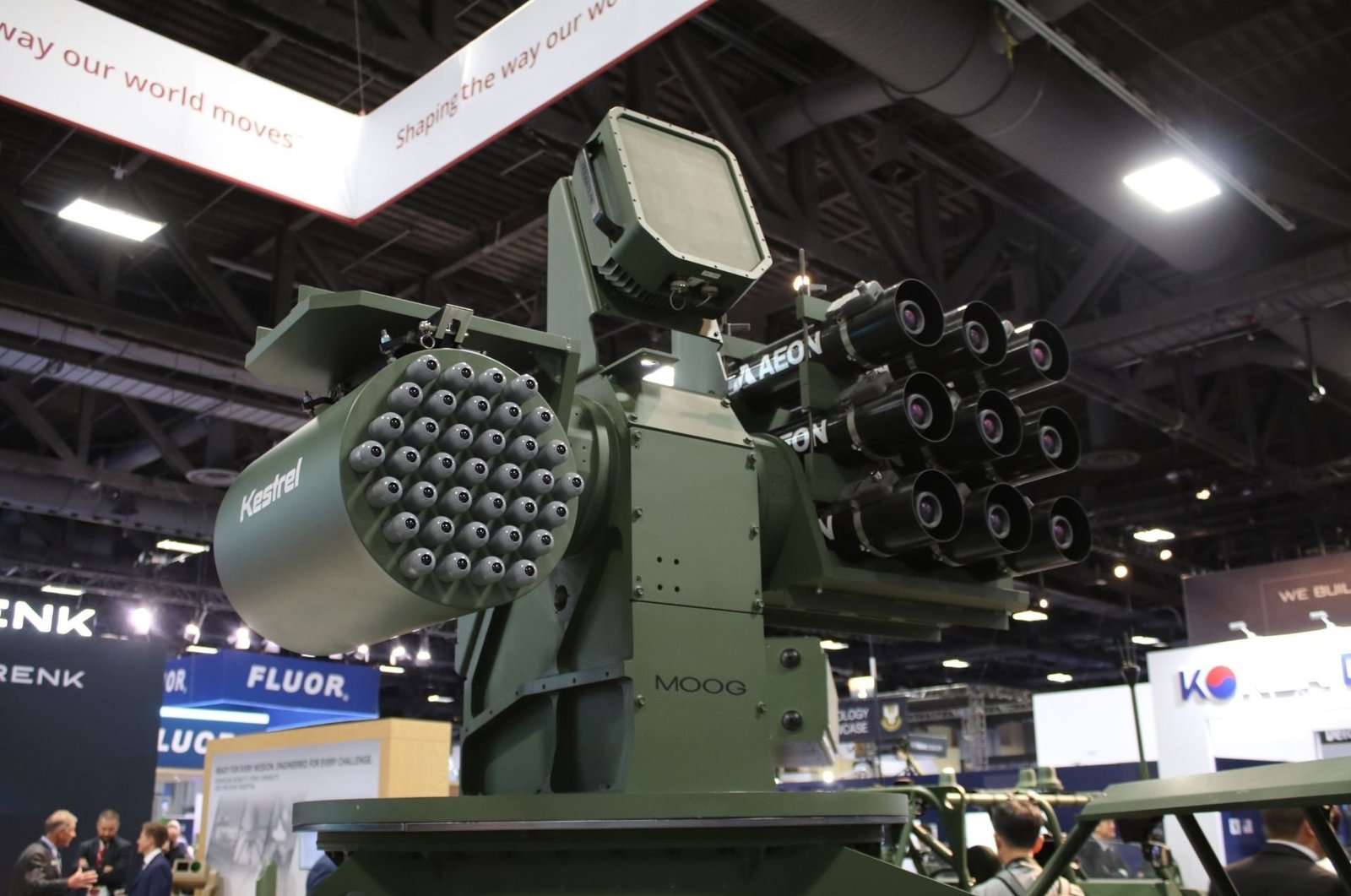
WASHINGTON, D.C., — American defense technology company Moog Inc. showcased its MR SLED (Moog Reconfigurable Self-Loading Equipment Dock) mobile defense system at the Association of the United States Army (AUSA) 2026 Annual Meeting and Exposition, held in Washington, D.C., from October 12 to 14. The system combines tactical missiles, drone interceptors, radar and digital command integration on a modular vehicle-mounted platform.
Lightweight Platform for Multiple Vehicles
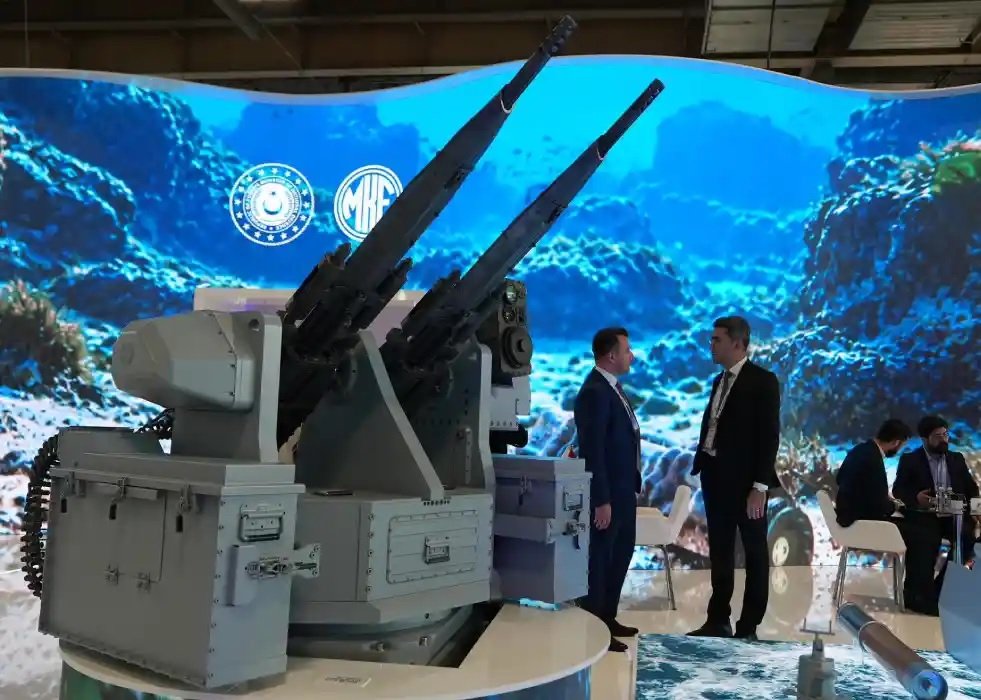
MR SLED is built around Moog’s Lightweight Reconfigurable Integrated-weapons Platform (RIwP), a lighter version of the standard RIwP used on the U.S. Army’s Stryker-based Mobile Short-Range Air Defense (M-SHORAD) vehicles, also known as SGT Stout.
The Lightweight RIwP base assembly weighs less than 950 pounds (approximately 431 kg), compared with around 2,500 pounds for the standard version. It retains the same software architecture, fire-control interfaces and support systems to simplify training and maintenance.
The system can be installed on pickup trucks, light tactical vehicles, Infantry Squad Vehicles, 6x6 platforms and unmanned ground vehicles (UGVs) without major custom modifications. One demonstration configuration used a BC Customs PSXV-XL-6X6 vehicle. Moog designed MR SLED to support short-range air defense, counter-unmanned aircraft systems (C-UAS) and future U.S. Army M-SHORAD Increment 4 requirements.
Zeus Missiles and Kestrel Interceptors
The demonstrated system combined Aeon Industrial’s Zeus tactical missiles with Moog’s Kestrel interceptors. Reports differ on the number of Zeus missiles carried, with configurations listing either nine or 12, alongside 37 Kestrel interceptors.
Originally developed by Texas-based Aeon as an anti-tank missile, Zeus has been adapted for air defense and precision-strike missions. Its publicly reported range is approximately 4–5 kilometres, with a speed exceeding Mach 0.65 and a 2.7 kg (6-pound) warhead. Its reported unit cost is around $50,000.
The missile uses Aeon’s ODIN targeting software for automatic threat identification, tracking and strike options. Its modular design supports payload changes and integration with different platforms, including vehicles and, in some configurations, shoulder-fired launchers.
Earlier in 2026, Aeon and Moog completed a guided flight test of Zeus launched from a Moog turret mounted on an unmanned ground vehicle. The missile hit its target on the first attempt.
The Kestrel interceptors are intended to counter small unmanned aircraft systems and loitering munitions. Their role is broadly comparable to low-cost kinetic interceptors such as the Kreuger 100, developed by Sweden’s Nordic Air Defence. However, detailed public specifications for Kestrel remain limited, and its interception performance against fast-moving or swarming drones has not been established by the available information.
Radar, Software and Additional Weapons
The AUSA configuration also integrated Echodyne’s EchoShield 3D pulse-Doppler active electronically scanned array (AESA) radar for search and tracking. The radar supports AI- and machine-learning-based target classification and operation while moving.
Picogrid’s Legion software provides digital integration and connections to command networks, allowing soldiers to coordinate sensors and weapons and reconfigure the system in the field. The RIwP architecture can also accommodate direct-fire weapons, including 30 mm cannons and machine guns, depending on the configuration.
Moog describes MR SLED as a scalable solution that can be adapted to the payload limits of different vehicles while using components common to existing Army air-defense and counter-drone programs. The platform was nominated for an AUSA Best New Product award.
Although the system offers a flexible combination of weapons and sensors, detailed public performance data for Kestrel and the complete MR SLED configuration remain limited. Its operational effectiveness against different aerial threats will depend on the capabilities demonstrated during testing and evaluation.
——— End of Article ———